PRODUCTS SOLD ON PEPTIDESLABEU.COM ARE FOR RESEARCH PURPOSES ONLY AND ARE NOT FOR HUMAN OR VETERINARY USE.

€113.00 – €343.50Price range: €113.00 through €343.50
SS-31 EU – Buy Online | In Stock & Ready to Ship
Buy SS-31 in Europe with fast shipping and guaranteed ≥99% purity — verified with COA and HPLC documentation. A trusted choice for peptides EU research teams rely on, with no customs delays or lengthy international wait times. Whether you’re searching for SS-31 Europe suppliers, looking to buy SS-31 in the EU, or sourcing peptides Europe-wide, we have you covered. Research teams across the EU can count on consistent stock, rapid fulfilment and full batch documentation every time.
For research use only. Not intended for human or veterinary use.



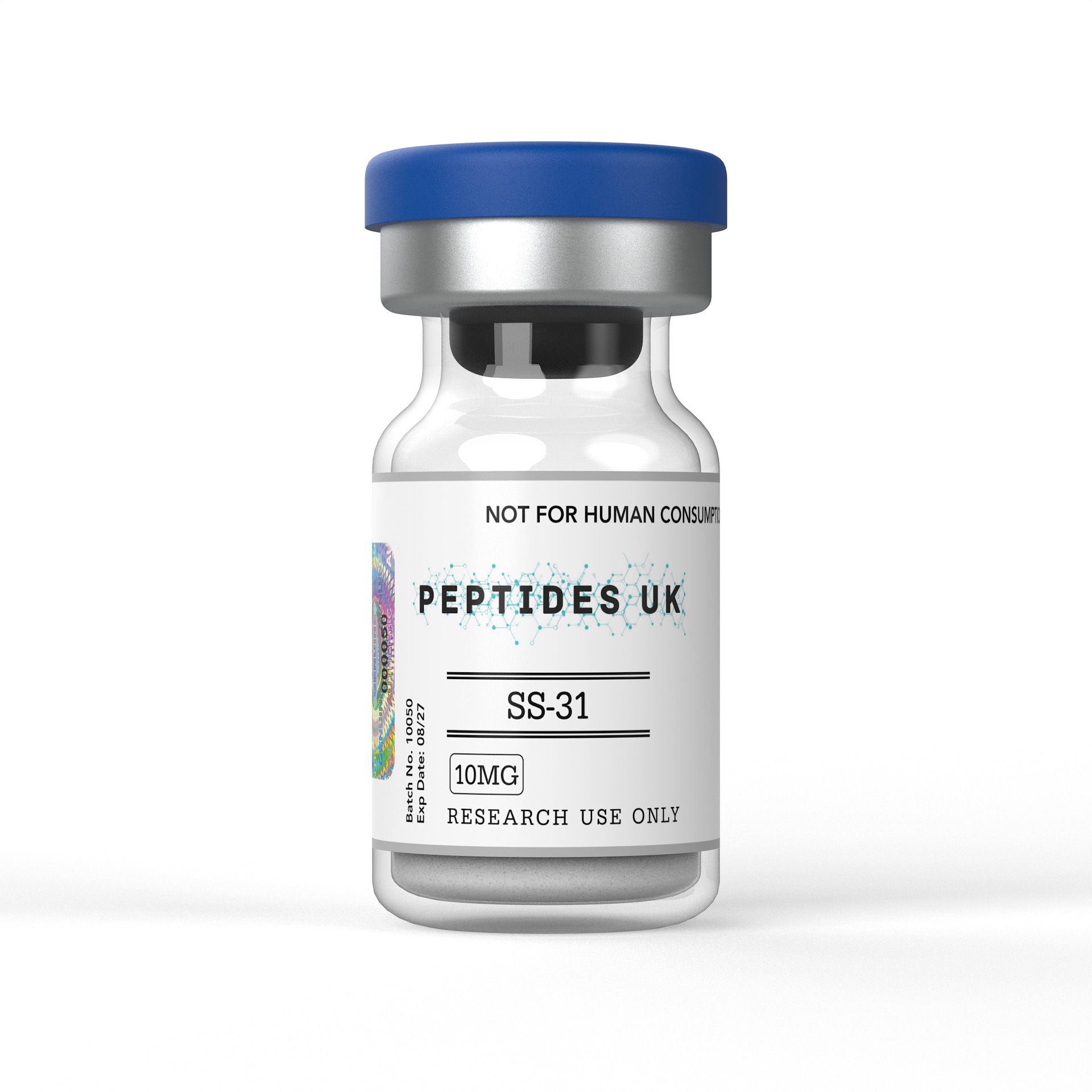
SS-31 — Elamipretide, designated MTP-131 and Bendavia in clinical development, sequence D-Arg-Dmt-Lys-Phe-NH₂ (where Dmt is 2′,6′-dimethyltyrosine), a synthetic aromatic-cationic tetrapeptide developed by Hazel H. Szeto and Peter W. Schiller — is the founding and most extensively characterised member of the Szeto-Schiller (SS) peptide class and the most clinically advanced mitochondria-targeting peptide in the biomedical research literature, having progressed through Phase I, II, and III clinical trials across heart failure, Barth syndrome, primary mitochondrial myopathy, age-related macular degeneration, acute myocardial infarction, acute kidney injury, and Leber hereditary optic neuropathy. SS-31’s mechanism is fundamentally distinct from all other mitochondria-targeting approaches: it does not require the mitochondrial membrane potential (ΔΨm) — the driving force for triphenylphosphonium-conjugate accumulation — instead using an alternating aromatic-cationic motif to traverse biological membranes energy-independently and accumulate 1,000–5,000-fold at the cardiolipin-rich inner mitochondrial membrane, where it directly stabilises cardiolipin, inhibits cytochrome c peroxidase activity, promotes respiratory supercomplex assembly and cristae curvature restoration, and reduces electron leakage-driven ROS production — while producing no detectable effect on healthy, normally functioning mitochondria. This dysfunction-selectivity distinguishes SS-31 as a research tool that interrogates mitochondrial pathology specifically rather than perturbing basal mitochondrial biology, making it an indispensable instrument for EU research into mitochondrial disease, ischaemia-reperfusion biology, ageing-associated bioenergetic decline, and any pathological context where cardiolipin oxidation and cristae disruption underlie cellular dysfunction. Research institutions and laboratories across the EU can source verified, research-grade SS-31 in Europe with fast dispatch and full batch documentation included.
✅ ≥99% Purity — HPLC & Mass Spectrometry Verified
✅ D-Arg N-Terminus & Dmt (2′,6′-Dimethyltyrosine) Confirmed — Batch-Specific CoA
✅ Sterile Lyophilised Powder | GMP Manufactured
✅ Fast Dispatch Across EU & Europe | EU Peptides Stock
SS-31 is a synthetic tetrapeptide — four amino acids, molecular weight approximately 640 Da — whose sequence D-Arg-Dmt-Lys-Phe-NH₂ embodies three structural principles simultaneously: an alternating aromatic-cationic architecture that enables membrane traversal and inner mitochondrial membrane (IMM) targeting, a Dmt (2′,6′-dimethyltyrosine) residue that confers both aromatic pi-stacking capacity for membrane interaction and a scavenging function for reactive oxygen species through the formation of stable Dmt-tyrosyl radicals, and a C-terminal amide conferring exopeptidase resistance. The overall formal charge of +3 at physiological pH — from the D-Arg guanidinium and the Lys ε-amine — provides the electrostatic attraction to the highly negatively charged cardiolipin-enriched IMM surface that drives intramitochondrial accumulation.
The discovery of SS-31 was serendipitous in origin. Hazel Szeto and Peter Schiller were investigating opioid receptor pharmacology using a library of short aromatic-cationic peptides designed for CNS penetration — when they observed, fortuitously, that several peptides in the series exhibited potent cytoprotective activity in oxidative stress paradigms that appeared uncorrelated with opioid receptor activity and instead correlated with mitochondrial accumulation. Subsequent mechanistic investigation — conducted at Weill Cornell Medical College from the early 2000s — revealed that the alternating aromatic-cationic motif was responsible for both the energy-independent membrane permeation and the highly selective IMM localisation, establishing a new pharmacological class of mitochondria-targeting agents distinct from all prior approaches.
The critical structural feature distinguishing SS-31 from all preceding mitochondria-targeted antioxidants — including MitoQ and SkQ1 (both triphenylphosphonium-conjugated antioxidants) — is its membrane-potential-independent accumulation mechanism. TPP-conjugated compounds accumulate in mitochondria driven by ΔΨm (the approximately −180 mV IMM electrochemical potential) — which means their accumulation is proportional to ΔΨm and therefore reduced precisely in the pathological contexts of most research interest, where mitochondrial dysfunction causes ΔΨm collapse. SS-31’s aromatic-cationic motif traverses biological membranes through an energy-independent, nonsaturable mechanism allowing 1,000–5,000-fold accumulation at the IMM regardless of ΔΨm — enabling it to reach and act upon depolarised, dysfunctional mitochondria that are inaccessible to TPP-conjugate agents. This property is mechanistically essential to SS-31’s utility in ischaemia-reperfusion, heart failure, and genetic mitochondrial disease research — all contexts where ΔΨm collapse is a central pathological feature.
Once at the IMM, SS-31 binds cardiolipin — an unusual dimeric anionic phospholipid with two phosphate headgroups and four acyl chains, constituting approximately 10–20% of IMM lipids and found in virtually no other mammalian membrane — through a combination of electrostatic interaction between SS-31’s cationic residues and cardiolipin’s anionic phosphate headgroups, and hydrophobic insertion of the aromatic Dmt and Phe side chains into the lipid bilayer interfacial region. This cardiolipin-targeting is the mechanistic basis of SS-31’s IMM selectivity — because cardiolipin is almost exclusively localised to the IMM, compounds with high cardiolipin affinity will selectively concentrate there regardless of the broader mitochondrial membrane architecture. Biophysical characterisation (solid-state NMR, molecular dynamics simulations, surface plasmon resonance) has established that SS-31 partitions into the membrane interfacial region rather than the hydrophobic core, and that this interaction alters cardiolipin’s molecular geometry, membrane curvature properties, and local electrostatic environment — with direct structural consequences for the respiratory machinery assembled on and around cardiolipin.
Cardiolipin Stabilisation and Cytochrome c Peroxidase Inhibition Research — SS-31’s primary molecular action at the IMM is the stabilisation of cardiolipin against oxidative peroxidation — a process that would otherwise generate peroxidised cardiolipin species driving cytochrome c release, MOMP, and apoptotic signalling. In normally functioning mitochondria, cytochrome c is loosely associated with IMM cardiolipin through an electrostatic interaction; under oxidative stress, peroxidised cardiolipin converts this association into a tighter hydrophobic interaction that transforms cytochrome c from an electron carrier (shuttling electrons between Complex III and Complex IV in the ETC) into a cardiolipin peroxidase — an enzyme that uses cytochrome c’s haem iron to catalyse further cardiolipin oxidation in a self-amplifying ROS-generating cycle that produces electron leakage, further ROS generation, and ultimately mitochondrial dysfunction and cell death. SS-31 binds cardiolipin’s phosphate headgroups in the IMM interfacial region and modulates the cardiolipin-cytochrome c interaction geometry — physically preventing the conformational change converting cytochrome c to its peroxidase form, preserving its electron carrier function, and interrupting the peroxidative amplification cycle at its initiation step. This cytochrome c peroxidase inhibition mechanism — characterised by Birk, Szeto, and colleagues — is the molecular explanation for SS-31’s ability to simultaneously improve electron transport and reduce ROS: it restores the ETC’s primary electron carrier function while suppressing the pathological electron leakage route.
Respiratory Supercomplex Assembly and Cristae Architecture Research — Cardiolipin is a structural scaffold for the assembly of respiratory complexes I, II, III, and IV into higher-order supercomplexes (respirasomes) — macromolecular assemblies that channel electron flux from NADH and FADH₂ through sequential respiratory complexes with minimal electron leakage to molecular oxygen and therefore minimal superoxide generation. Supercomplex assembly depends critically on cardiolipin’s physical chemistry — its unique conical molecular geometry and propensity to promote negative membrane curvature at the IMM cristae is essential for the tight-radius curvature of cristae tips where respiratory supercomplex density is highest. When cardiolipin is oxidised or reduced in content — as in Barth syndrome (tafazzin/TAZ mutations causing defective cardiolipin remodelling), ischaemia-reperfusion injury, ageing, and heart failure — supercomplexes destabilise, respiratory complex activity falls, and electron leakage-driven ROS production increases. SS-31 binding to cardiolipin restores its physical geometry and IMM surface electrostatics — documented by cryo-electron microscopy and Seahorse XF respirometry to improve cristae curvature, increase cristae connectivity and density, restore supercomplex organisation, and improve respiratory coupling efficiency (P/O ratio) in aged, ischaemic, and Barth syndrome mitochondria. PNAS chemical cross-linking mass spectrometry identified SS-31’s protein interaction landscape in mitochondria as falling into two groups: OXPHOS-pathway proteins (including components of Complexes I–V and ANT) and 2-oxoglutarate metabolic pathway proteins — both groups being known cardiolipin-binding proteins, confirming that SS-31’s effects on respiratory function are mediated through cardiolipin-dependent protein interactions rather than direct enzyme binding.
ATP Synthasome Stabilisation Research — Beyond respiratory supercomplex stabilisation, SS-31 stabilises the ATP synthasome — a cardiolipin-dependent macromolecular supercomplex comprising ATP synthase (Complex V), adenine nucleotide translocase (ANT), and the inorganic phosphate carrier (PiC), with creatine kinase in cardiac and muscle tissue — that couples the proton motive force generated by the ETC directly to ATP synthesis and its export from the mitochondrial matrix to the cytosol. Cardiolipin is required for ANT activity and for optimal ATP synthase F₁F₀ coupling — its peroxidation or depletion reduces ANT-mediated ADP/ATP exchange and compromises the proton conductance through F₀ that drives F₁ ATP synthesis. SS-31 stabilisation of cardiolipin in the ATP synthasome environment restores the coupled proton-to-ATP conversion efficiency — documented as improved state 3 respiration, improved P/O ratios, and increased ATPmax in aged skeletal muscle mitochondria after 8-week SS-31 treatment.
Dysfunction-Selective Pharmacology Research — One of SS-31’s most important and mechanistically instructive properties is its complete absence of effect on normally functioning healthy mitochondria — documented independently by multiple groups in young animals, healthy cell lines, and normal mitochondrial preparations. This dysfunction-selectivity is mechanistically explained by the cytochrome c peroxidase inhibition mechanism: in healthy mitochondria, cardiolipin is not oxidised, cytochrome c is not converted to its peroxidase form, and ETC electron flux is already optimally coupled — there is no pathological process for SS-31 to interrupt. SS-31 therefore functions as a conditional bioenergetic restorer rather than a universal metabolic enhancer — selectively active in pathological mitochondria where cardiolipin oxidation is driving ETC dysfunction, and silent in healthy mitochondria. This selectivity has profound implications for research design: SS-31 serves as an internal control for the pathological specificity of cardiolipin oxidation, and its presence or absence of effect in a given cell or tissue model provides information about whether cardiolipin-driven dysfunction is operative in that system.
Cardiac Ischaemia-Reperfusion Research — Cardiac ischaemia-reperfusion injury is the paradigmatic context for SS-31’s cardioprotective biology — with myocardial ischaemia causing progressive cardiolipin peroxidation, cristae disruption, and Complex I/III inactivation during the ischaemic period, and reperfusion triggering a burst of ETC-driven ROS that amplifies the peroxidative cycle and drives mitochondria-mediated cardiomyocyte death through the mitochondrial permeability transition pore (mPTP). SS-31 administered before ischaemia or during early reperfusion re-energises ischaemic mitochondria — documented to restore ΔΨm, reduce mPTP opening, improve complex I and III activity, reduce infarct size, and preserve cardiac contractile function in pre-clinical ischaemia-reperfusion models across multiple species (rat, dog, pig, rabbit). The mechanistic sequence — cardiolipin stabilisation → cytochrome c peroxidase inhibition → supercomplex preservation → ΔΨm restoration → mPTP resistance — provides a coherent explanation for the comprehensive cardioprotective phenotype and positions SS-31 as the research tool of choice for dissecting cardiolipin-specific contributions to ischaemia-reperfusion injury biology.
Heart Failure and Cardiac Bioenergetics Research — Chronic heart failure is characterised by progressive mitochondrial bioenergetic insufficiency — with reduced Complex I activity, cardiolipin oxidation and depletion, supercomplex destabilisation, and increased mitochondrial ROS production — contributing to cardiomyocyte dysfunction, adverse cardiac remodelling, and the energy-starved state that characterises the failing heart. SS-31 treatment in pre-clinical dog and rodent heart failure models improved mitochondrial morphology and function, restored cardiac ATP production, reduced cardiac hypertrophy and fibrosis, and normalised myocardial energetics. In the 8-week aged mouse cardiac study (Chiao et al., eLife, 2020) — old mice with pre-existing mitochondrial dysfunction and diastolic impairment — SS-31 treatment normalised proton leak, reduced mitochondrial ROS, improved cardiac phosphorylation of cMyBP-C Ser282, and reversed diastolic dysfunction to near-young levels, while the same treatment produced no functional improvement in young mice with healthy mitochondria — directly confirming the dysfunction-selective pharmacology in the cardiac aging context.
Skeletal Muscle Ageing and Sarcopenia Research — Age-associated sarcopenia — progressive loss of skeletal muscle mass and function — is substantially driven by mitochondrial bioenergetic decline in skeletal muscle fibres, with reduced ATPmax, impaired oxidative phosphorylation coupling, cardiolipin oxidation, and cristae disruption documented in aged muscle across species including humans. Campbell et al. (Free Radical Biology and Medicine, 2019) demonstrated that 8-week SS-31 treatment in aged mice reversed age-related ATPmax decline and oxidative phosphorylation coupling impairment, restored redox homeostasis through reversal of cysteine S-glutathionylation post-translational modifications across the skeletal muscle proteome, increased gastrocnemius muscle mass, and significantly improved treadmill endurance — without increasing mitochondrial protein content, establishing that SS-31 improves mitochondrial quality (efficiency per existing mitochondrion) rather than mitochondrial quantity. These findings provide a mechanistic framework for SS-31 research in ageing-associated exercise intolerance and sarcopenia, and a rodent model reference for the human ageing skeletal muscle pharmacology relevant to EU longevity research programmes.
Acute Kidney Injury and Renal Biology Research — Renal tubular epithelial cells have exceptionally high mitochondrial density — making the kidney a primary site of ischaemia-reperfusion mitochondrial dysfunction and a major research application for SS-31. Pre-clinical ischaemic AKI models demonstrated SS-31-driven improvements in renal tubular architecture, reduction of proximal tubular apoptosis, restoration of GFR, and reduction of oxidative tubular injury — with protection initiated even when SS-31 was administered 1 month after ischaemia in a chronic kidney disease model, demonstrating that already-established post-ischaemic nephropathy is partially reversible by cardiolipin-targeted therapy. In diabetic nephropathy models, SS-31 reduced cardiolipin oxidation in podocytes, decreased proteinuria, and attenuated mesangial expansion — implicating cardiolipin peroxidation as a driver of diabetic glomerular pathology and SS-31 as a tool for dissecting mitochondrial contributions to diabetic kidney disease biology.
Neurodegeneration and Neuroprotection Research — SS-31 crosses the blood-brain barrier — enabled by the aromatic-cationic motif’s cell penetration mechanism — and accumulates at neuronal mitochondria. Pre-clinical research has documented SS-31’s neuroprotective biology across multiple neurodegeneration-relevant paradigms: preservation of synaptic mitochondria in ageing neurons (synaptic mitochondria are the most vulnerable to age-associated oxidative damage), inhibition of Aβ-induced mitochondrial dysfunction and synaptic loss in Alzheimer’s disease models, attenuation of MPTP-induced dopaminergic neurotoxicity in Parkinson’s disease models, and preservation of retinal ganglion cell mitochondrial function in optic neuropathy models. SS-31 also inhibits mPTP opening — the mitochondrial permeability transition pore whose opening under cellular stress releases cytochrome c and initiates the apoptotic cascade — providing an anti-apoptotic neuroprotective mechanism relevant to both acute neurological injury (traumatic brain injury, stroke) and chronic neurodegenerative contexts.
Primary Mitochondrial Disease Research — The most direct mechanistic research application for SS-31 is in primary mitochondrial diseases — genetic conditions characterised by OXPHOS complex deficiencies, mtDNA deletions or mutations, and tRNA point mutations that impair the respiratory chain and reduce cellular ATP supply. SS-31’s ability to stabilise whatever cardiolipin-dependent supercomplex architecture remains in genetically impaired mitochondria — maximising the bioenergetic output of partially functional respiratory complexes — provides a mechanism-agnostic approach applicable across the genetic heterogeneity of primary mitochondrial myopathies, regardless of which specific complex or mtDNA gene is mutated. In Barth syndrome — where tafazzin mutations directly cause defective cardiolipin remodelling, producing the monolysocardiolipin (MLCL)/mature CL imbalance that directly destabilises supercomplexes — the mechanistic rationale for SS-31 is most directly aligned, as SS-31 acts on the downstream consequence of the genetic defect (aberrant cardiolipin) at precisely the point where it impairs OXPHOS.
Age-Related Macular Degeneration Research — The photoreceptor ellipsoid zone — the outer segment/inner segment junction of rod and cone photoreceptors — is among the most mitochondria-dense tissue layers in the human body, with photoreceptor mitochondria supplying the continuous ATP demand of phototransduction. In dry AMD, progressive photoreceptor degeneration is associated with mitochondrial dysfunction in the ellipsoid zone, making SS-31 mechanistically relevant to AMD biology. The ReCLAIM-2 clinical study of elamipretide in geographic atrophy secondary to dry AMD documented slowing of ellipsoid zone degradation — a predictor of photoreceptor degeneration — in elamipretide-treated subjects versus placebo, providing clinical pharmacodynamic evidence that SS-31’s cardiolipin-stabilising mechanism is active in photoreceptor mitochondria in vivo.
Pre-Clinical Bioenergetic and Structural Data — A foundational body of pre-clinical research across cardiac, renal, skeletal muscle, and neuronal systems has consistently documented SS-31’s ability to restore mitochondrial bioenergetics in dysfunctional mitochondria — with Seahorse XF respirometry, ³¹P-MRS in vivo ATP production measurement, electron microscopy cristae morphology analysis, and JC-1/TMRM membrane potential assays providing converging evidence for SS-31’s effects on ETC coupling, Complex I/III activity, cristae architecture, and ΔΨm restoration. The consistent finding across these studies that SS-31 produces no improvement in healthy young mitochondria while substantially restoring function in aged, ischaemic, or genetically dysfunctional mitochondria has been independently replicated by multiple research groups, establishing the dysfunction-selective pharmacology as a robust and reproducible property of SS-31.
PROGRESS-HF (Heart Failure with Preserved Ejection Fraction) — A Phase 2 randomised controlled trial of elamipretide in heart failure with preserved ejection fraction (HFpEF) — a condition driven substantially by mitochondrial bioenergetic dysfunction in cardiac muscle — documented statistically significant improvements in 6-minute walk distance and patient-reported quality of life, providing clinical pharmacodynamic evidence for SS-31’s cardiac bioenergetic restoration mechanism in a human heart failure population. HFpEF represents one of the few clinical trial contexts where SS-31 produced positive primary endpoint results in humans.
TAZPOWER (Barth Syndrome) — A Phase 2/3 randomised double-blind placebo-controlled crossover trial in 12 subjects with genetically confirmed Barth syndrome assessed 40 mg/day subcutaneous elamipretide for 12 weeks. Neither primary endpoint was met (6-minute walk test distance and Barth Syndrome Symptom Assessment scale) in the double-blind period. However, the 36-week open-label extension — in which all 10 continuing subjects received elamipretide continuously — documented statistically significant improvements in 6MWT distance and symptom scores, raising the question of whether the 12-week crossover design was insufficient to capture the full therapeutic response of a cardiolipin remodelling-dependent structural bioenergetic restoration mechanism. A natural history comparison study (Hornby et al., 2022) using historical controls provided additional evidence for elamipretide-associated functional improvement in Barth syndrome.
MMPOWER-3 (Primary Mitochondrial Myopathy) — The pivotal Phase 3 randomised double-blind placebo-controlled trial of 218 subjects with genetically confirmed primary mitochondrial myopathy receiving 40 mg/day subcutaneous elamipretide for 24 weeks did not meet its co-primary endpoints of 6-minute walk test distance improvement and PMMSA total fatigue score improvement. The trial was well-tolerated — injection site reactions were the most frequent adverse event, with no serious adverse events attributable to elamipretide — establishing SS-31’s safety profile at 40 mg/day subcutaneous dosing. Post-hoc analysis has focused on the heterogeneity of primary mitochondrial myopathies as a potential explanation for the primary endpoint failure and has motivated investigation of more homogeneous patient subgroup enrichment strategies for future trials.
ReCLAIM-2 (Dry AMD / Geographic Atrophy) — The Phase 2 randomised controlled trial in geographic atrophy secondary to dry AMD did not meet its primary endpoints of low-luminance best-corrected visual acuity and square root geographic atrophy area change. However, elamipretide was associated with statistically significant slowing of ellipsoid zone degradation — the mitochondria-dense photoreceptor layer — providing mechanistic evidence for IMM cardiolipin-stabilising activity in retinal photoreceptor biology and a secondary endpoint signal for further investigation.
| Feature | SS-31 (Elamipretide) | MitoQ | SkQ1 |
|---|---|---|---|
| Class | Aromatic-cationic tetrapeptide | TPP-conjugated ubiquinone | TPP-conjugated plastoquinone |
| Mitochondrial Targeting Mechanism | Membrane-potential-independent — aromatic-cationic motif | ΔΨm-dependent — TPP cation accumulation | ΔΨm-dependent — TPP cation accumulation |
| Primary Target | Cardiolipin — IMM interfacial binding | ETC electron shuttling / ROS scavenging | ROS scavenging |
| Effective in Depolarised Mitochondria | Yes — ΔΨm-independent | No — reduced accumulation with ΔΨm collapse | No — reduced accumulation with ΔΨm collapse |
| Dysfunction Selectivity | Yes — no effect on healthy mitochondria | No — affects ROS in healthy cells | No |
| Cytochrome c Peroxidase Inhibition | Yes — primary mechanism | No | No |
| Supercomplex Stabilisation | Yes — cardiolipin-mediated | Indirect | No |
| Cristae Architecture Restoration | Yes — documented by cryo-EM | No | No |
| ATP Synthasome Stabilisation | Yes | No | No |
| Clinical Trial Programme | Phase I–III — multiple indications | Phase II (heart failure — negative) | Phase II (dry AMD — negative) |
| Research Utility | Cardiolipin-specific dysfunction probe; multi-indication bioenergetic restoration | Mitochondrial ROS scavenging comparator | Plastoquinone-based ROS comparator |
| Parameter | Specification |
|---|---|
| Full Name | SS-31 / Elamipretide / MTP-131 / Bendavia |
| Also Known As | Elamipretide / MTP-131 / Bendavia / D-Arg-Dmt-Lys-Phe-NH₂ |
| Sequence | D-Arg-Dmt-Lys-Phe-NH₂ |
| Dmt Definition | 2′,6′-Dimethyltyrosine — modified tyrosine residue; aromatic IMM anchor + ROS scavenging |
| Peptide Class | Szeto-Schiller (SS) Aromatic-Cationic Tetrapeptide |
| Molecular Weight | ~640 Da |
| CAS Number | 736992-21-5 |
| Formal Charge | +3 at physiological pH (D-Arg guanidinium + Lys ε-amine + C-terminus) |
| Mitochondrial Accumulation | 1,000–5,000-fold at IMM — ΔΨm-independent |
| Primary Molecular Target | Cardiolipin (CL) — IMM-specific anionic phospholipid |
| Key Mechanisms | Cardiolipin stabilisation; cytochrome c peroxidase inhibition; supercomplex restoration; cristae architecture; ATP synthasome stabilisation; mPTP inhibition |
| Dysfunction Selectivity | No effect on healthy mitochondria — active only in dysfunctional mitochondria |
| BBB Penetration | Yes — aromatic-cationic motif enables CNS penetration |
| Purity | ≥99% HPLC & MS Verified |
| Form | Sterile Lyophilised Powder |
| Solubility | Sterile water or PBS — excellent aqueous solubility |
| Storage (Powder) | -20°C; protect from light and moisture |
| Storage (Reconstituted) | 4°C up to 7 days; -20°C single-use aliquots |
| Bundle Size | 10mg |
SS-31 reconstitutes readily in sterile water or PBS — add solvent slowly to the lyophilised powder and swirl gently until dissolved. Excellent aqueous solubility reflecting the +3 charge and highly water-compatible residue composition. No acidic reconstitution conditions required. No disulphide bonds — no reducing agent incompatibilities. The D-Arg N-terminus is stable under standard aqueous conditions and confirmed by mass spectrometry; the Dmt (2′,6′-dimethyltyrosine) residue is chemically stable under aqueous storage and the methyl groups are confirmed by mass spectrometry on every batch — their absence would indicate substitution with unmodified tyrosine, abolishing the aromatic-cationic amplitude and dramatically reducing IMM accumulation efficiency and ROS-scavenging biology.
For cell-based in vitro assays — working concentrations of 0.1–10 µM are commonly used in Seahorse XF respirometry, JC-1/TMRM membrane potential assays, MitoSOX ROS quantification, and cytochrome c peroxidase activity assays; empirical dose-response characterisation should be performed for each cell type and endpoint, as effective concentrations vary with mitochondrial density, degree of pre-existing dysfunction, and the specific parameter measured. For ischaemia-reperfusion cell culture paradigms, SS-31 is typically added to the medium before the hypoxia/anoxia period, at reoxygenation, or both — with the timing of administration an experimental variable with significant mechanistic implications given the stepwise nature of ischaemia-reperfusion mitochondrial injury. Prepare single-use aliquots at -20°C following reconstitution. Avoid repeated freeze-thaw cycles.
Every SS-31 order dispatched across the EU and Europe includes:
✅ Batch-Specific Certificate of Analysis (CoA)
✅ HPLC Chromatogram
✅ Mass Spectrometry Confirmation — D-Arg, Dmt (2′,6′-dimethyltyrosine), and C-terminal amide verification
✅ Sterility & Endotoxin Testing Report
✅ Reconstitution Protocol
✅ Technical Research Support
Yes — research-grade SS-31 (Elamipretide) is available to EU and European researchers with fast dispatch and full batch documentation. Supplied strictly for laboratory research purposes only.
Unlike TPP-conjugated compounds (MitoQ, SkQ1) whose accumulation is driven by ΔΨm and therefore reduced when mitochondria are depolarised, SS-31’s alternating aromatic-cationic motif traverses biological membranes through an energy-independent, nonsaturable mechanism — driven by electrostatic attraction to cardiolipin’s anionic headgroups rather than the global IMM electrochemical potential. This allows SS-31 to accumulate in and act upon depolarised, dysfunctional mitochondria — precisely the pathological context of greatest research interest — where ΔΨm-dependent agents lose activity.
Cardiolipin is an unusual dimeric anionic phospholipid (two phosphate headgroups, four acyl chains) constituting 10–20% of IMM lipids and found in virtually no other mammalian membrane. It is the structural scaffold for respiratory supercomplex assembly, cristae curvature maintenance, ATP synthasome integrity, and cytochrome c electron carrier function. When cardiolipin is peroxidised — by ETC-derived ROS under conditions of mitochondrial stress — supercomplexes destabilise, cristae architecture disrupts, and cytochrome c converts to a cardiolipin peroxidase that amplifies the damage. SS-31 interrupts this cycle at its initiation step by stabilising cardiolipin before peroxidation can progress.
In healthy mitochondria, cardiolipin is not oxidised, cytochrome c is not in its peroxidase conformation, and ETC electron flux is already optimally coupled through intact supercomplexes — there is no peroxidative amplification cycle for SS-31 to interrupt. SS-31 is a conditional bioenergetic restorer that corrects a specific pathological process (cardiolipin peroxidation-driven dysfunction) rather than a universal metabolic enhancer. This selectivity makes it an ideal research tool for determining whether cardiolipin-driven dysfunction is operative in a given experimental system.
Results have been mixed. PROGRESS-HF (HFpEF) met primary endpoints with improvements in 6-minute walk distance and quality of life — a positive clinical signal. TAZPOWER (Barth syndrome) did not meet primary endpoints in the blinded 12-week crossover period but showed significant improvement in the 36-week open-label extension. MMPOWER-3 (primary mitochondrial myopathy, n=218) did not meet primary endpoints. ReCLAIM-2 (dry AMD) did not meet primary endpoints but showed ellipsoid zone preservation signals. All trials confirmed SS-31’s safety — injection site reactions were the predominant adverse event. These nuanced outcomes make SS-31 a particularly important research tool for understanding the methodological challenges of conducting OXPHOS-endpoint trials in heterogeneous mitochondrial disease populations.
Vehicle control (matched sterile water or PBS) is essential. A young/healthy cell comparator alongside the aged or diseased cell model directly tests the dysfunction-selectivity in each specific system. Cardiolipin depletion controls (using cardiolipin synthesis inhibitors or CL-deficient cell lines) help determine whether SS-31 effects are cardiolipin-dependent. For mechanistic attribution, MitoSOX/MitoTracker co-staining with and without SS-31 distinguishes ROS-scavenging from ETC-coupling restoration contributions. mPTP opening assays (calcein-AM/CoCl₂ quenching) isolate the SS-31 mPTP inhibition component from its ETC-coupling effects.
≥99% HPLC with mass spectrometry confirming D-Arg (stereochemistry), Dmt (2′,6′-dimethyltyrosine — not unmodified Tyr), Lys, Phe, and the intact C-terminal amide is essential. Substitution of Dmt with unmodified Tyr eliminates both the enhanced aromatic contribution to IMM partitioning and the Dmt-tyrosyl radical ROS-scavenging mechanism, producing a substantially less potent compound. D-Arg epimerisation to L-Arg would alter the conformational dynamics of the aromatic-cationic motif and potentially reduce IMM accumulation efficiency. Both modifications are confirmed by mass spectrometry with each batch CoA.
SS-31 (Elamipretide) is supplied exclusively for legitimate scientific research purposes conducted within licensed laboratory environments across the EU and Europe. This product is not intended for human consumption, self-administration, or any therapeutic application. It must be handled by qualified researchers in compliance with applicable EU regulations and institutional biosafety guidelines. By purchasing, you confirm that this compound will be used solely for approved in vitro or pre-clinical research purposes.


Receive News
