PRODUCTS SOLD ON PEPTIDESLABEU.COM ARE FOR RESEARCH PURPOSES ONLY AND ARE NOT FOR HUMAN OR VETERINARY USE.
€60.00
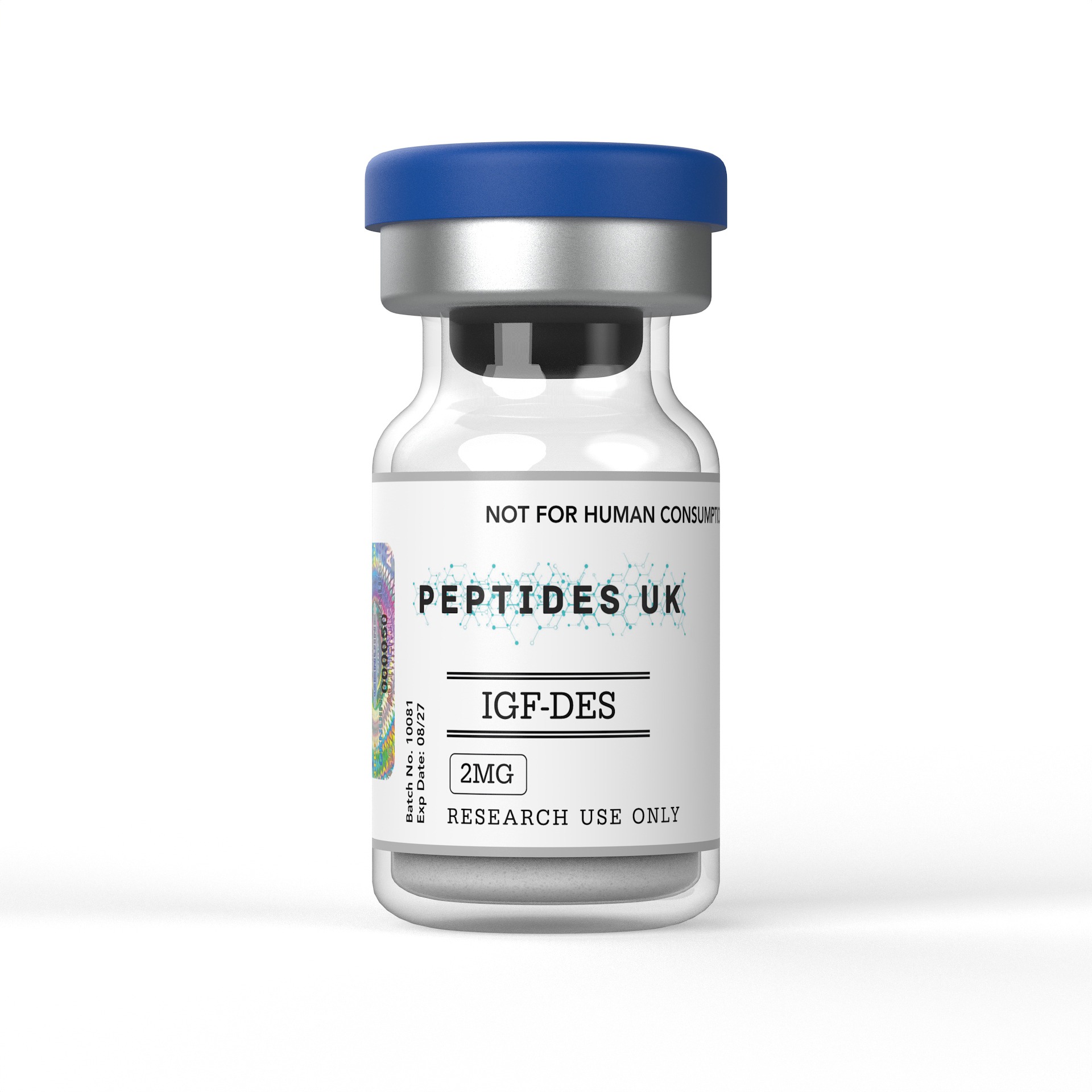
IGF-DES EU – Buy Online | In Stock & Ready to Ship
Buy IGF-DES in Europe with fast shipping and guaranteed ≥99% purity — verified with COA and HPLC documentation. A trusted choice for peptides EU research teams rely on, with no customs delays or lengthy international wait times. Whether you’re searching for IGF-DES Europe suppliers, looking to buy IGF-DES in the EU, or sourcing peptides Europe-wide, we have you covered. Research teams across the EU can count on consistent stock, rapid fulfilment and full batch documentation every time.
For research use only. Not intended for human or veterinary use.

IGF-1 DES is a naturally occurring truncated isoform of Insulin-like Growth Factor 1, available to buy in Europe for laboratory research into IGF-1 receptor pharmacology, local tissue growth factor biology, satellite cell activation, IGF-binding protein resistance, and the comparative pharmacology of IGF-1 axis peptides.
Laboratories and research institutions across the EU can order verified, research-grade IGF-1 DES with fast international dispatch to Europe, full batch documentation, and ≥99% purity confirmed by HPLC and Mass Spectrometry.
✅ ≥99% Purity — HPLC & Mass Spectrometry Verified
✅ Batch-Specific Certificate of Analysis (CoA)
✅ Sterile Lyophilised Powder | GMP Manufactured
✅ Fast Dispatch to EU & Europe | Tracked Shipping
IGF-1 DES (Des(1-3)IGF-1) is a naturally occurring truncated isoform of human Insulin-like Growth Factor 1, arising through proteolytic cleavage of the N-terminal tripeptide (Gly-Pro-Glu) from the full-length 70-amino acid IGF-1 molecule. This N-terminal truncation produces a 67-amino acid peptide that retains the full IGF-1 receptor (IGF-1R) binding domain while exhibiting profoundly altered interactions with the IGF-binding protein (IGFBP) family — a structural distinction with major consequences for its biological potency and tissue-level activity.
IGF-1 DES was first identified in human brain tissue and colostrum, where its natural occurrence suggested a role in local tissue growth factor signalling distinct from the endocrine IGF-1 produced by the liver under GH stimulation. Its characterisation as a high-potency, IGFBP-resistant IGF-1 isoform — binding IGFBPs with approximately 1000-fold lower affinity than intact IGF-1 while retaining full IGF-1R agonism — established it as a uniquely important research tool for studying the IGF-1 axis independent of IGFBP-mediated regulation.
The three-amino acid N-terminal truncation that defines IGF-1 DES eliminates the primary IGFBP binding determinant without disrupting the receptor-binding regions of the IGF-1 molecule. Because circulating and tissue IGFBPs sequester the vast majority of IGF-1 in an inactive, receptor-inaccessible pool, IGF-1 DES bypasses this regulatory mechanism entirely — producing receptor engagement and downstream signalling in the presence of IGFBP concentrations that would effectively neutralise equivalent amounts of intact IGF-1. This IGFBP resistance makes IGF-1 DES a uniquely powerful tool for studying IGF-1R signalling in physiologically relevant IGFBP-containing environments and for dissecting IGFBP-dependent versus IGFBP-independent components of the IGF-1 axis.
In laboratory settings, IGF-1 DES is studied across IGF-1 receptor pharmacology, cell proliferation biology, satellite cell and myoblast research, neurobiology, and comparative IGF-1 isoform pharmacology. EU and European researchers working with IGF-1 DES typically focus on:
IGF-1 receptor pharmacology and signalling — IGF-1 DES is a full-potency IGF-1R agonist, activating the receptor’s intrinsic tyrosine kinase and initiating the canonical downstream signalling cascades — PI3K/Akt/mTOR and Ras/MAPK/ERK — with equivalent or superior potency to intact IGF-1 in the presence of IGFBPs. Studies use IGF-1 DES to characterise IGF-1R activation kinetics, downstream phosphorylation cascades, and receptor-mediated transcriptional programmes in contexts where IGFBP sequestration of intact IGF-1 would confound results.
IGFBP resistance and IGF-1 axis biology — The defining pharmacological feature of IGF-1 DES is its ~1000-fold reduction in IGFBP binding affinity compared to intact IGF-1. Studies use this property to dissect the contributions of IGFBP-bound versus free IGF-1 to tissue-level IGF signalling — examining how IGFBP family members (IGFBP-1 through IGFBP-6) regulate IGF-1 bioavailability, tissue access, and receptor engagement in physiologically relevant cell and tissue systems.
Satellite cell activation and myoblast biology — IGF-1 DES has been documented as a potent activator of skeletal muscle satellite cells — the resident stem cells responsible for muscle repair, hypertrophy, and regeneration. Studies examine IGF-1 DES-driven satellite cell proliferation, myoblast differentiation, and myotube formation in models of muscle growth and regeneration, with its IGFBP resistance providing enhanced activity in muscle tissue environments where IGFBPs are abundant.
Cell proliferation and differentiation research — IGF-1 DES-driven IGF-1R activation produces potent mitogenic and pro-survival signalling across diverse cell types — including muscle, bone, cartilage, epithelial, and neural cell populations. Studies use IGF-1 DES as an IGFBP-resistant proliferative stimulus to examine IGF-1R-mediated cell cycle progression, anti-apoptotic signalling, and differentiation programmes in contexts where intact IGF-1 activity is partially suppressed by endogenous IGFBPs.
PI3K/Akt/mTOR pathway research — IGF-1R activation by IGF-1 DES drives robust PI3K-dependent Akt phosphorylation and downstream mTORC1 activation — a central signalling node in cell growth, protein synthesis, and survival regulation. Studies use IGF-1 DES to examine mTOR pathway activation dynamics, S6K1 and 4E-BP1 phosphorylation, and the downstream translational consequences of IGF-1R/PI3K/Akt/mTOR axis engagement in research on cell growth regulation, anabolic signalling, and cancer biology.
Local versus systemic IGF-1 biology — IGF-1 DES’s natural occurrence as a locally produced, IGFBP-resistant isoform — in contrast to the endocrine, IGFBP-bound systemic IGF-1 produced by the liver — makes it a research tool for studying autocrine and paracrine IGF-1 signalling. Studies examining local tissue IGF biology, wound healing, and tissue repair use IGF-1 DES to model the high-potency, locally bioavailable IGF-1 activity that differs fundamentally from the systemically regulated, IGFBP-sequestered circulating IGF-1 pool.
Neurobiology and neuroprotection research — IGF-1 DES was first characterised in brain tissue, where it is produced locally and acts through neuronal IGF-1R to promote neuronal survival, differentiation, and synaptic plasticity. Studies use IGF-1 DES to examine IGF-1R-mediated neuroprotection, neuronal proliferation, and the role of locally produced, IGFBP-resistant IGF-1 isoforms in brain IGF biology — including models of neurodegeneration and neural injury.
Bone and cartilage biology — IGF-1R activation is a primary driver of osteoblast and chondrocyte proliferation, differentiation, and anabolic activity. Studies in bone and cartilage biology use IGF-1 DES as an IGFBP-resistant IGF-1R agonist to examine osteoblast mineralisation, chondrocyte matrix synthesis, and the contributions of IGFBP regulation to skeletal tissue IGF signalling — with IGF-1 DES enabling receptor-level IGF-1R activation in IGFBP-rich skeletal tissue environments.
Comparative IGF-1 isoform pharmacology — IGF-1 DES is systematically studied alongside intact recombinant IGF-1, Long-R3 IGF-1, and mechano-growth factor (MGF) in comparative pharmacology studies — characterising differences in receptor affinity, IGFBP binding, potency in IGFBP-containing versus IGFBP-free conditions, and cell-type-specific activity profiles across the IGF-1 isoform family. These comparative studies provide the reference data defining IGF-1 DES’s unique pharmacological position within the IGF-1 axis research toolkit.
Cancer biology and IGF-1R oncology research — IGF-1R overexpression and dysregulated IGF signalling are implicated in the proliferation, survival, and metastasis of multiple tumour types. Studies use IGF-1 DES as an IGFBP-resistant IGF-1R agonist to examine IGF-1R-driven oncogenic signalling in cancer cell lines — investigating PI3K/Akt/mTOR and MAPK pathway activation, resistance to IGF-1R-targeted therapies, and the relationship between IGF-1 bioavailability and tumour biology in IGFBP-expressing tumour microenvironments.
Wound healing and tissue repair models — IGF-1 DES has been examined in wound healing and tissue repair models — where locally produced, IGFBP-resistant IGF-1 isoforms are implicated in the proliferative and remodelling phases of tissue repair. Studies use IGF-1 DES to examine IGF-1R-mediated fibroblast and keratinocyte proliferation, extracellular matrix production, and the local IGF signalling that drives tissue regeneration in the presence of IGFBP-rich wound environments.
Insulin receptor cross-reactivity and metabolic research — At high concentrations, IGF-1 DES engages the insulin receptor (IR) through its structural homology with insulin — with implications for glucose metabolism research. Studies examining the metabolic versus growth-promoting signalling tradeoffs of IGF-1R versus IR engagement, and the selectivity of IGF-1 isoforms for each receptor, use IGF-1 DES alongside intact IGF-1 and insulin in comparative receptor pharmacology experiments.
All research applications are for in vitro and pre-clinical use only.
IGF-1 DES has a substantial and mechanistically important research literature — with studies characterising its natural occurrence and biosynthesis, its IGFBP resistance mechanism, and its broad biological activity across multiple tissue systems.
Natural occurrence and biosynthesis characterisation: IGF-1 DES was first identified in human brain tissue and colostrum in the late 1980s and early 1990s, with studies characterising it as the product of N-terminal proteolytic cleavage of intact IGF-1 — most likely by a specific brain protease acting on the Gly-Pro-Glu N-terminal tripeptide. Studies documenting its natural occurrence in brain, intestinal mucosa, and colostrum established the physiological relevance of the truncated isoform and motivated systematic pharmacological characterisation of the consequences of N-terminal truncation for IGF-1R binding and IGFBP interactions.
IGFBP binding characterisation: Foundational biochemical studies systematically quantified IGF-1 DES’s dramatically reduced affinity for IGFBP-1 through IGFBP-6 compared to intact IGF-1 — establishing the ~1000-fold reduction in IGFBP binding that is the defining pharmacological feature of the truncated isoform. These studies characterised the N-terminal Gly-Pro-Glu tripeptide as a critical structural determinant of IGFBP binding — its removal producing IGFBP resistance without disrupting the C-domain and A-domain receptor binding residues that engage IGF-1R.
Enhanced potency in IGFBP-containing systems: Comparative studies examining IGF-1 DES versus intact IGF-1 in cell assay systems containing physiological IGFBP concentrations consistently documented IGF-1 DES’s superior potency — producing equivalent or greater receptor activation and downstream biological responses at lower concentrations than intact IGF-1 when IGFBPs were present. These findings provided experimental validation of the IGFBP resistance mechanism and established the practical consequence for cell biology research applications.
Satellite cell and muscle biology: Studies characterising IGF-1 DES’s activity in skeletal muscle documented potent activation of satellite cell proliferation and myoblast differentiation — with findings establishing IGF-1 DES as a highly active stimulus for muscle cell IGF-1R signalling in IGFBP-expressing muscle tissue environments. These muscle biology findings have established IGF-1 DES as a key research tool in satellite cell and skeletal muscle regeneration research.
Neurotrophic and neuroprotective activity: Studies in neural cell systems documented IGF-1 DES-driven neuronal survival, differentiation, and neurite outgrowth through IGF-1R/PI3K/Akt and MAPK signalling — consistent with the proposed role of locally produced truncated IGF-1 isoforms in brain IGF biology. Neuroprotection studies documented IGF-1 DES’s capacity to protect neurons against apoptotic stimuli through Akt-mediated survival signalling.
Comparative IGF-1 isoform studies: Studies systematically comparing IGF-1 DES to intact IGF-1 and Long-R3 IGF-1 — another IGFBP-resistant IGF-1 analogue designed for research applications — characterised the relative potency, receptor selectivity, and IGFBP resistance of each isoform. These comparative studies established that IGF-1 DES and Long-R3 IGF-1 achieve IGFBP resistance through fundamentally different structural mechanisms — N-terminal truncation versus Arg³ substitution — with similar functional consequences for cell-based research applications.
Bone and cartilage research: Studies in osteoblast and chondrocyte systems documented IGF-1 DES-driven proliferation, differentiation, and anabolic activity through IGF-1R activation — with findings establishing that IGFBP resistance enhances the effective potency of the truncated isoform in skeletal tissue environments where IGFBP-3 and IGFBP-5 are abundantly expressed.
| Compound | Structure | IGFBP Binding | IGF-1R Potency | Key Research Distinction |
|---|---|---|---|---|
| IGF-1 DES | N-terminal truncation (Δ1–3) | ~1000× reduced | Full agonist | IGFBP-resistant; naturally occurring truncated isoform |
| Intact IGF-1 (rhIGF-1) | Full 70 aa sequence | High | Full agonist | Reference IGF-1; IGFBP-regulated |
| Long-R3 IGF-1 | Arg³ substitution + 13 aa N-terminal extension | Very low | Full agonist | IGFBP-resistant analogue; research/cell culture standard |
| IGF-2 | Distinct 67 aa sequence | Moderate (IGFBP-6 preference) | IGF-1R + IGF-2R | IGF-2R biology; imprinting research |
| MGF (Mechano-Growth Factor) | IGF-1 splice variant — Ea/Eb peptide | Distinct | IGF-1R (via MGF peptide) | Mechanically regulated; muscle satellite cell research |
| Insulin | 51 aa A/B chains | No IGFBP binding | IR >> IGF-1R | Metabolic control; IR pharmacology reference |
Every order of IGF-1 DES dispatched to EU and European research institutions includes:
Can I Buy IGF-1 DES in the EU and Europe?
Yes. We supply research-grade IGF-1 DES with fast tracked dispatch to all EU member states and wider European destinations. All orders include full batch documentation. IGF-1 DES is supplied strictly for laboratory research use only.
What is the Structural Difference Between IGF-1 DES and Intact IGF-1?
IGF-1 DES lacks the N-terminal tripeptide Gly-Pro-Glu that begins the intact IGF-1 sequence, resulting in a 67-amino acid peptide versus the full-length 70-amino acid molecule. This truncation eliminates the primary structural determinant responsible for high-affinity binding to the IGFBP family — producing approximately 1000-fold reduction in IGFBP binding affinity — while preserving the C-domain and A-domain residues that constitute the IGF-1 receptor binding surface.
Why Does IGFBP Resistance Make IGF-1 DES More Potent in Cell Assays?
In physiological and cell culture environments containing IGFBPs — including serum-supplemented culture media — the majority of intact IGF-1 exists in inactive IGFBP-bound complexes that cannot engage IGF-1R. IGF-1 DES bypasses IGFBP sequestration entirely, meaning virtually all added peptide is available for receptor engagement. The result is substantially higher effective potency in IGFBP-containing systems — often requiring significantly lower concentrations of IGF-1 DES than intact IGF-1 to produce equivalent receptor activation and downstream responses.
What is the Difference Between IGF-1 DES and Long-R3 IGF-1?
Both are IGFBP-resistant IGF-1 analogues widely used in cell biology research, but they achieve IGFBP resistance through fundamentally different mechanisms. IGF-1 DES is a naturally occurring N-terminal truncation isoform — lacking the first three amino acids of intact IGF-1. Long-R3 IGF-1 is a synthetic analogue incorporating an Arg³ point mutation alongside a 13-amino acid N-terminal extension. Both exhibit substantially reduced IGFBP binding and enhanced potency in IGFBP-containing systems, but differ in molecular weight, stability characteristics, and secondary pharmacology — making comparative studies between the two isoforms a productive research application.
Where is IGF-1 DES Naturally Produced?
IGF-1 DES has been identified in human brain tissue, intestinal mucosa, and colostrum. In these tissues, it is believed to arise through proteolytic processing of intact IGF-1 or direct expression of a truncated isoform, functioning as a locally acting, IGFBP-resistant growth factor with autocrine and paracrine signalling roles distinct from the endocrine, hepatically produced, IGFBP-regulated circulating IGF-1 pool.
How Does IGF-1 DES Relate to the GH/IGF-1 Axis?
Circulating IGF-1 is produced primarily by the liver under stimulation from pituitary growth hormone — constituting the endocrine arm of the GH/IGF-1 axis. IGF-1 DES represents the locally produced, tissue-specific arm of IGF-1 biology — where truncated, IGFBP-resistant isoforms act in an autocrine and paracrine manner independently of systemic GH/IGF-1 axis regulation. Research combining GH secretagogues (GHRPs, GHRH analogues) with IGF-1 DES enables parallel investigation of the systemic and local limbs of IGF-1 biology in the same experimental framework.
How Do I Reconstitute IGF-1 DES for Laboratory Use?
Reconstitute with sterile water or appropriate laboratory buffer (PBS or 0.1% BSA in PBS is recommended to minimise adsorption) by adding solvent slowly down the vial wall and swirling gently — do not vortex. Prepare working stocks at required concentration, aliquot into single-use volumes to avoid repeated freeze-thaw, and store at -80°C. Carrier protein addition (e.g., 0.1% BSA) is advisable for dilute stock solutions to minimise peptide loss through surface adsorption.
How Quickly is IGF-1 DES Delivered to Europe?
Delivery to EU and European destinations typically takes 3–7 working days via tracked international courier with packaging maintaining peptide stability throughout transit.
| Parameter | Detail |
|---|---|
| Full Name | Des(1-3)IGF-1 / IGF-1 DES |
| Structure | 67-amino acid truncated IGF-1 isoform; N-terminal Gly-Pro-Glu deleted |
| Origin | Naturally occurring proteolytic IGF-1 isoform |
| Primary Receptor | IGF-1R (Insulin-like Growth Factor 1 Receptor) — full agonist |
| IGFBP Binding | ~1000× reduced versus intact IGF-1 — IGFBP resistant |
| Downstream Signalling | PI3K/Akt/mTOR; Ras/MAPK/ERK |
| Potency vs IGF-1 | Superior in IGFBP-containing environments; equivalent in IGFBP-free systems |
| Primary Research Interest | IGF-1R pharmacology, IGFBP resistance biology, satellite cell activation, neurobiology, cancer IGF signalling |
| Purity | ≥99% |
| Verification | HPLC & Mass Spectrometry |
| Form | Sterile Lyophilised Powder |
| Solubility | Sterile water or laboratory buffer (0.1% BSA in PBS recommended) |
| Storage | -20°C, protected from light and moisture |
| Intended Use | Research use only |
IGF-1 DES is supplied exclusively for legitimate scientific research conducted within licensed laboratory environments. This product is not approved for human consumption, self-administration, or any therapeutic, clinical, or veterinary application. It must be handled solely by qualified researchers in compliance with applicable EU regulations, national legislation, and institutional ethics guidelines. By purchasing, you confirm this compound will be used exclusively for approved in vitro or pre-clinical research purposes.
Receive News
