PRODUCTS SOLD ON PEPTIDESLABEU.COM ARE FOR RESEARCH PURPOSES ONLY AND ARE NOT FOR HUMAN OR VETERINARY USE.

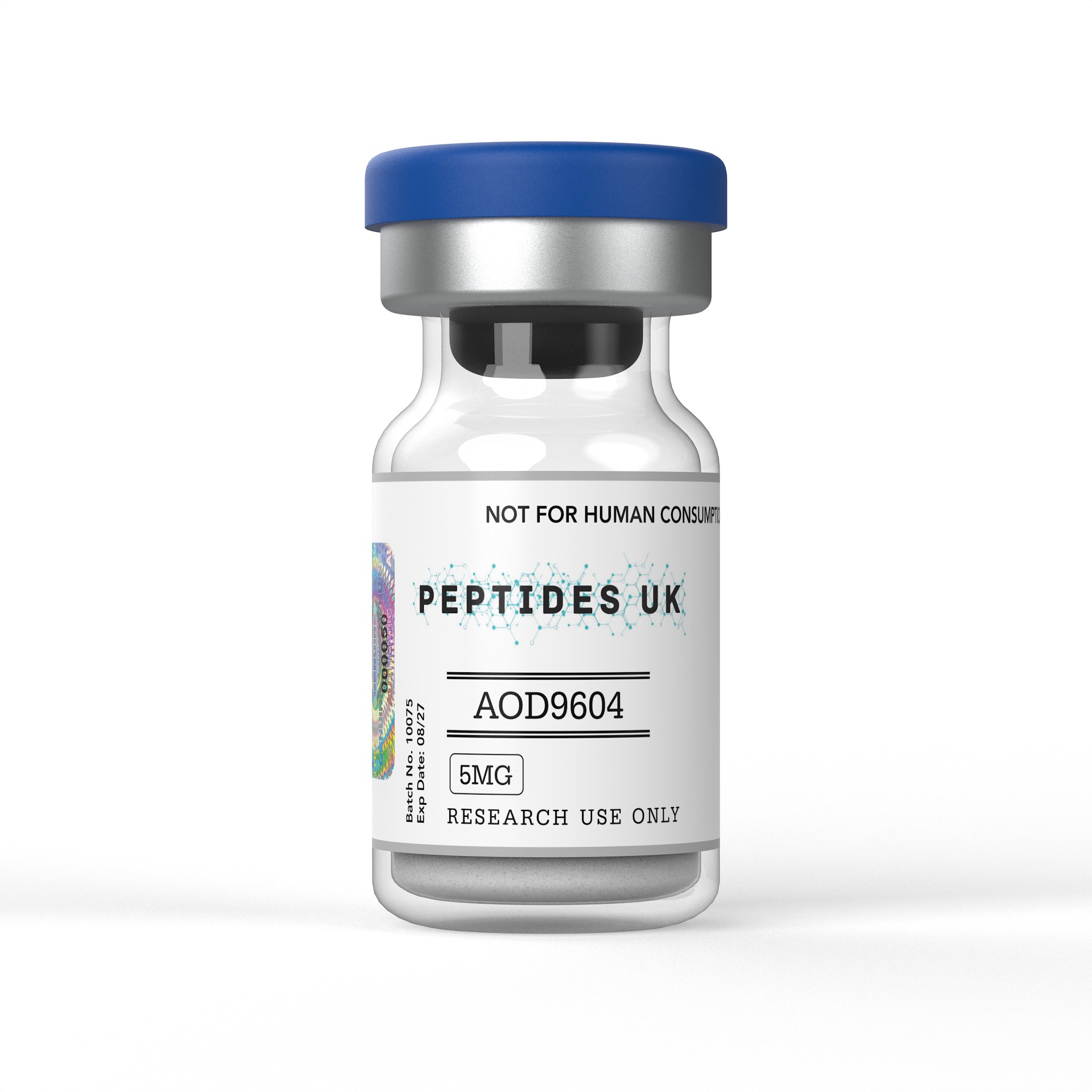
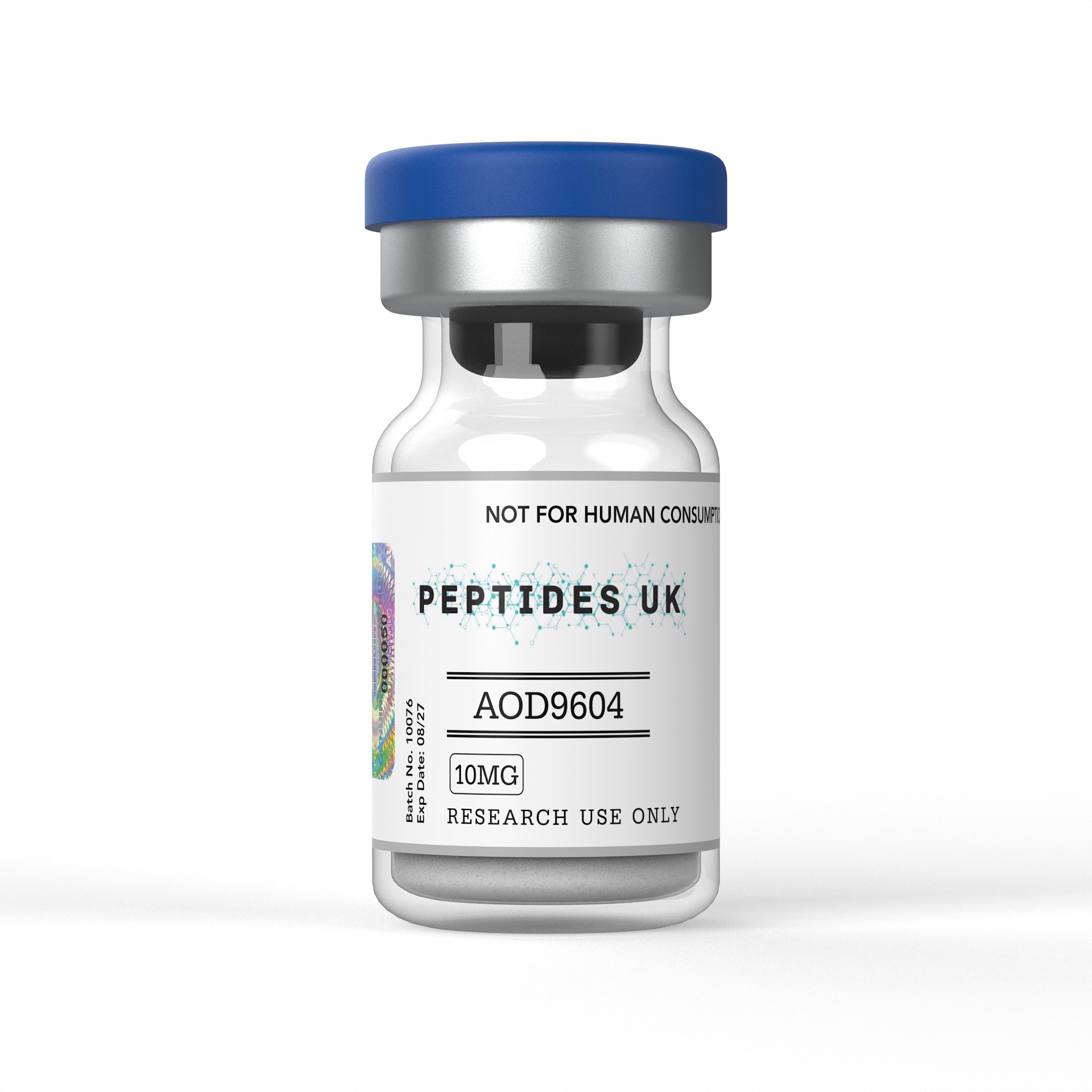
€29.00 – €121.00Price range: €29.00 through €121.00
AOD9604 EU – Buy Online | In Stock & Ready to Ship
Buy AOD9604 in Europe with fast shipping and guaranteed ≥99% purity — verified with COA and HPLC documentation. A trusted choice for peptides EU research teams rely on, with no customs delays or lengthy international wait times. Whether you’re searching for AOD9604 Europe suppliers, looking to buy AOD9604 in the EU, or sourcing peptides Europe-wide, we have you covered. Research teams across the EU can count on consistent stock, rapid fulfilment and full batch documentation every time.
For research use only. Not intended for human or veterinary use.


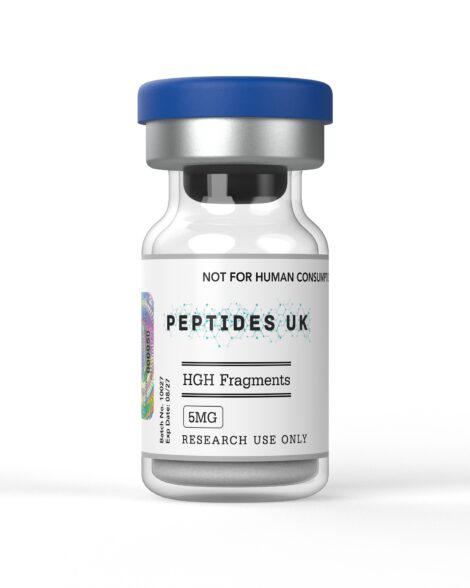
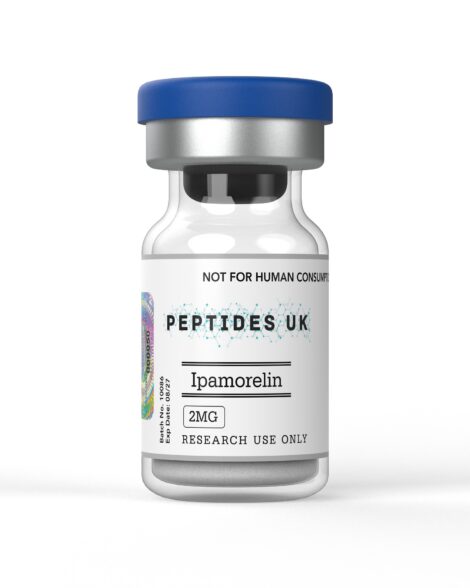
AOD9604 — Advanced Obesity Drug 9604, a stabilised synthetic analogue of the C-terminal lipolytic domain of human growth hormone — is one of the most extensively safety-characterised GH-derived lipolytic research peptides available to laboratories across Europe, combining selective beta-3 adrenergic receptor-mediated lipolytic biology with the US FDA GRAS designation that distinguishes it as the most rigorously evaluated GH C-terminal domain peptide in the research literature. Research institutions and laboratories across the EU can source verified, research-grade AOD9604 in Europe with fast dispatch and full batch documentation included.
✅ ≥99% Purity — HPLC & Mass Spectrometry Verified
✅ Batch-Specific Certificate of Analysis (CoA) Included
✅ Sterile Lyophilised Powder | GMP Manufactured
✅ Fast Dispatch Across EU & Europe | EU Peptides Stock
AOD9604 — sequence Tyr-Leu-Arg-Ile-Val-Gln-Cys-Arg-Ser-Val-Glu-Gly-Ser-Cys-Gly-Phe, with an N-terminal tyrosine addition stabilising the peptide relative to its parent compound — is a synthetic 17-amino acid peptide representing the structurally refined successor to HGH Fragment 176-191 in the GH C-terminal lipolytic domain research programme. It was developed at Monash University under the direction of Professor Frank Ng through a targeted pharmacological optimisation programme seeking to isolate and stabilise the lipolytic biological activity residing in the C-terminal region of human growth hormone — specifically the beta-3 adrenergic receptor-sensitising activity that drives adipocyte lipolysis and anti-lipogenic biology through a growth hormone receptor-independent mechanism.
The key structural difference between AOD9604 and HGH Fragment 176-191 is the addition of an N-terminal tyrosine residue — corresponding to Tyr176 of the native GH sequence — that provides enhanced conformational stability to the peptide’s three-dimensional architecture and contributes to the disulphide bridge geometry essential for full lipolytic potency. The Cys7-Cys14 disulphide bridge in AOD9604 — corresponding to the Cys182-Cys189 bridge in HGH Fragment 176-191 — is absolutely essential for biological activity, constraining the peptide into the correct loop conformation for beta-3 adrenergic receptor sensitisation and downstream cAMP-hormone sensitive lipase activation in adipocytes.
AOD9604 received US FDA Generally Recognised As Safe designation following an extensive safety evaluation programme — establishing it as the most safety-characterised GH C-terminal domain peptide and the most rigorously evaluated GH-derived lipolytic research compound available to European laboratories. This GRAS designation, combined with the clinical investigation history of AOD9604 in human obesity trials, provides a translational research context and human safety dataset that is unique among GH-derived lipolytic research peptides and establishes AOD9604 as the reference compound for studying GH C-terminal domain lipolytic biology in the context of clinically translatable research.
In controlled laboratory and pre-clinical research settings across EU and European institutions, AOD9604 is studied across GH-derived lipolytic biology, beta-3 adrenergic receptor sensitisation, adipose tissue metabolism, anti-lipogenic biology, comparative GH fragment pharmacology, cartilage and chondroprotective biology, and translational obesity research:
GH C-Terminal Domain Lipolytic Biology and Beta-3 Adrenergic Sensitisation Research — AOD9604 is the reference GRAS-designated GH C-terminal domain peptide for studying GH-derived selective lipolytic biology through beta-3 adrenergic receptor sensitisation. Research has characterised AOD9604’s lipolytic mechanism — examining beta-3 adrenergic receptor sensitisation in primary adipocytes and adipocyte cell line models, cAMP production following AOD9604-driven beta-3 adrenergic receptor activation, hormone sensitive lipase phosphorylation and activation kinetics, triglyceride hydrolysis rates and free fatty acid release in AOD9604-treated adipocyte preparations, and the disulphide bridge geometry requirements for beta-3 adrenergic sensitisation activity. These lipolytic biology studies establish AOD9604 as the GRAS reference for studying GH C-terminal domain fat mobilisation biology in EU adipose tissue research programmes.
GHR-Independent Selective Lipolysis Research — AOD9604’s lipolytic biology operates through a growth hormone receptor-independent mechanism — the peptide does not activate the GHR-JAK2-STAT5 pathway, does not stimulate IGF-1 production, and does not produce the insulin resistance associated with full-length GH receptor activation. Research has characterised AOD9604’s GHR independence — confirming absence of GHR binding, JAK2 phosphorylation, STAT5 activation, and IGF-1 axis stimulation under AOD9604 treatment, and establishing that the lipolytic biology produced by AOD9604 is entirely attributable to beta-3 adrenergic receptor-mediated cAMP signalling rather than GHR-downstream biology. These GHR-independence studies are critical for interpreting AOD9604’s selective lipolytic profile and distinguish it mechanistically from full-length HGH 191AA’s GHR-mediated lipolysis in comparative GH biology research.
Anti-Lipogenic Biology and Fat Accumulation Research — AOD9604 produces not only lipolytic but also anti-lipogenic biological effects — inhibiting lipid synthesis and fat accumulation in adipocyte models through mechanisms complementary to its pro-lipolytic beta-3 adrenergic biology. Research has examined AOD9604’s anti-lipogenic profile — characterising lipid synthesis rate reductions in AOD9604-treated adipocyte preparations, fatty acid synthase and ACC enzyme activity modulation, adipogenic gene expression changes including PPAR-gamma and C/EBP-alpha, and the net body composition biology of combined lipolytic and anti-lipogenic AOD9604 activity in rodent obesity models. These anti-lipogenic studies establish AOD9604 as a research tool for studying the dual fat-mobilising and fat-synthesis-inhibiting biology of GH C-terminal domain peptides in adipose tissue biology research.
Visceral Versus Subcutaneous Adipose Biology Research — GH-driven lipolysis preferentially mobilises visceral adipose tissue relative to subcutaneous fat depots — a depot selectivity characteristic that AOD9604 has been investigated for in pre-clinical adipose biology research. Research has examined AOD9604’s depot-selective lipolytic biology — characterising beta-3 adrenergic receptor expression differences between visceral and subcutaneous adipocyte populations, differential lipolytic response amplitudes across fat depot types, and the relationship between AOD9604’s selective beta-3 adrenergic mechanism and the visceral fat preference documented for full-length GH-driven lipolysis. These depot-selective studies contribute to understanding of how GH C-terminal domain peptide biology relates to the visceral fat-selective lipolytic biology of the complete GH-GHR axis.
Cartilage Biology and Chondroprotective Research — AOD9604 has been characterised as producing chondroprotective biology in cartilage and osteoarthritis research models — an application extending beyond adipose lipolytic biology into musculoskeletal research that is unique among GH C-terminal domain peptides. Research has examined AOD9604’s cartilage biology — characterising chondrocyte proliferation responses, proteoglycan synthesis stimulation, matrix metalloproteinase expression changes in cartilage tissue models, and the anti-inflammatory biology in joint tissue relevant to osteoarthritis pathology. These chondroprotective studies have broadened AOD9604’s research significance beyond its founding adipose lipolytic application and established a musculoskeletal research dimension relevant to EU orthopaedic and rheumatology research programmes examining GH-derived peptide biology in joint tissue.
Comparative GH Fragment Pharmacology Research — AOD9604 and HGH Fragment 176-191 are the two primary GH C-terminal lipolytic domain research compounds available to EU laboratories — and their structural relationship and pharmacological comparison is a defined research programme examining the consequences of N-terminal tyrosine addition and conformational stabilisation on lipolytic biology. Research employs AOD9604 alongside HGH Fragment 176-191 in parallel lipolytic biology studies — characterising comparative lipolytic potency in adipocyte models, disulphide bridge geometry contributions to beta-3 adrenergic sensitisation efficacy, the pharmacokinetic profile differences between the two peptides, and the cartilage biology that appears more pronounced in AOD9604 relative to HGH Fragment 176-191. These comparative pharmacology studies establish the structure-activity relationships governing GH C-terminal domain lipolytic biology and the pharmacological consequences of the structural refinement introduced by AOD9604.
Translational Obesity and Clinical Safety Research Context — AOD9604’s clinical investigation history in human obesity trials and its FDA GRAS designation provide a translational research context unavailable for HGH Fragment 176-191 — enabling pre-clinical AOD9604 research to be conducted with reference to human pharmacokinetic, safety, and preliminary efficacy data. Research has used AOD9604 in pre-clinical obesity models with direct reference to clinical trial findings — characterising pre-clinical lipolytic biology in the context of human dose-response data, comparing pre-clinical fat mobilisation outcomes with clinical body composition changes, and using the GRAS safety dataset to contextualise toxicological findings from pre-clinical AOD9604 research. This translational research context makes AOD9604 the preferred GH C-terminal domain peptide for EU research programmes with translational or clinical application goals.
Disulphide Bridge Biology and Conformational Requirements Research — AOD9604’s Cys7-Cys14 disulphide bridge is essential for biological activity — and research has examined the conformational requirements for beta-3 adrenergic sensitisation activity using reduced versus oxidised AOD9604 preparations and disulphide bridge-modified analogues. Research has characterised the disulphide bridge geometry requirements for AOD9604 biological activity — confirming substantial activity reduction in reduced peptide preparations, examining the loop conformation produced by Cys7-Cys14 bridging and its relevance to receptor contact geometry, and using Ellman’s reagent assays to verify disulphide bridge integrity in AOD9604 research preparations. These conformational biology studies contribute to understanding of the structural basis of GH C-terminal domain lipolytic activity.
Research and clinical investigation have produced an extensively characterised profile for AOD9604 across lipolytic biology, safety, and translational obesity research:
Pre-clinical lipolytic biology research has consistently documented AOD9604’s selective fat mobilisation in rodent obesity models — characterising body fat reduction, free fatty acid release increases, and adipose tissue beta-3 adrenergic biology under AOD9604 treatment. These pre-clinical lipolytic studies established AOD9604 as a pharmacologically active GH C-terminal domain peptide with selective fat mobilisation biology independent of GHR activation.
FDA GRAS designation has been documented following comprehensive safety evaluation — establishing AOD9604 as the most extensively safety-characterised GH-derived lipolytic peptide and providing the human safety reference dataset that distinguishes it from all other GH C-terminal domain research compounds available to EU laboratories.
Clinical obesity trial research has examined AOD9604 in human participants — characterising pharmacokinetic profiles, dose-response relationships for body composition changes, and safety parameters across multiple dose groups. These human trial data provide the translational reference dataset connecting pre-clinical AOD9604 lipolytic biology to clinically relevant outcomes and establishing the pharmacokinetic parameters for contextualising pre-clinical research findings.
GHR-independent mechanism research has confirmed absence of IGF-1 axis stimulation and insulin resistance induction — establishing that AOD9604’s lipolytic biology operates through the selective beta-3 adrenergic pathway without engaging the GHR-JAK2-STAT5 pathway responsible for the anabolic, IGF-1 axis, and insulin-antagonistic biology of full-length GH.
Cartilage biology research has documented AOD9604’s chondroprotective effects in osteoarthritis models — characterising cartilage matrix protection, chondrocyte proliferation stimulation, and anti-inflammatory biology in joint tissue that extends AOD9604’s documented biological activity beyond adipose lipolysis into musculoskeletal research applications.
| Feature | AOD9604 | HGH Fragment 176-191 | HGH 191AA | CJC-1295 With DAC | Ipamorelin | Tesamorelin |
|---|---|---|---|---|---|---|
| Type | Stabilised GH C-terminal analogue — N-Tyr addition — 17-aa | GH C-terminal lipolytic domain fragment — 16-aa | Full-length recombinant 191aa somatotropin | Tetrasubstituted GHRH(1-29) + DAC — long-acting GHRHR agonist | Synthetic pentapeptide selective GHS-R1a agonist | Full-length GHRH(1-44) — trans-3-hexenoic acid modified |
| Lipolytic Mechanism | Beta-3 adrenergic sensitisation — GHR independent | Beta-3 adrenergic sensitisation — GHR independent | GHR-JAK2-STAT5 → hormone sensitive lipase | Indirect — via GH secretion → GHR | Indirect — via GH secretion → GHR | Indirect — via GH secretion → GHR |
| GHR Activation | No — GHR independent | No — GHR independent | Yes — complete sequential dimerisation | No — indirect via secreted GH | No — indirect via secreted GH | No — indirect via secreted GH |
| IGF-1 Stimulation | No — selective | No — selective | Yes — direct hepatic GHR-STAT5 | Indirect via GH | Indirect via GH | Indirect via GH |
| Insulin Resistance | No — GHR independent | No — GHR independent | Yes — GH insulin antagonism | Indirect | Indirect | Indirect |
| Disulphide Bridge | Yes — Cys7-Cys14 — essential | Yes — Cys182-Cys189 — essential | Yes — two bridges — both essential | No | No | No |
| Cartilage Biology | Yes — documented | Limited data | Indirect via IGF-1 | Indirect | Limited | Limited |
| GRAS Designation | Yes — FDA GRAS | No | No | No | No | No |
| Clinical Investigation | Yes — human obesity trials | Limited | Extensive — approved rhGH | No | No | Yes — FDA approved Egrifta |
| N-Terminal Tyr | Yes — Tyr addition vs Fragment 176-191 | No — starts at Leu176 position | Full sequence | N/A | N/A | N/A |
| Key Research Distinction | GRAS-designated structurally refined GH C-terminal lipolytic domain — cartilage biology — clinical human data — most safety-characterised GH fragment | Parent GH lipolytic domain fragment — GHR-independent selective lipolysis reference | Complete GH biology reference — full GHR activation | Only long-acting GHRH — multi-day GH axis | Defining selective GHS-R1a reference | Only full-length DPP-IV-stabilised GHRH(1-44) |
| Parameter | Specification |
|---|---|
| Full Name | AOD9604 / Advanced Obesity Drug 9604 |
| Also Known As | AOD-9604 / Tyr-hGH Fragment 177-191 / stabilised GH C-terminal analogue |
| Sequence | Tyr-Leu-Arg-Ile-Val-Gln-Cys-Arg-Ser-Val-Glu-Gly-Ser-Cys-Gly-Phe |
| Type | Synthetic 17-Amino Acid Stabilised GH C-Terminal Lipolytic Analogue — GRAS Designated — Research Grade |
| Molecular Weight | ~1815.1 Da |
| Disulphide Bridge | Cys7-Cys14 — essential for beta-3 adrenergic sensitisation activity — NO reducing agents |
| N-Terminal Modification | N-terminal Tyr addition — conformational stabilisation relative to HGH Fragment 176-191 |
| Mechanism | Beta-3 adrenergic receptor sensitisation → adipocyte cAMP → hormone sensitive lipase activation → lipolysis + anti-lipogenic biology — GHR independent — no IGF-1 — no insulin resistance |
| GRAS Status | Yes — US FDA Generally Recognised As Safe designation |
| Clinical Investigation | Yes — human obesity clinical trials conducted |
| Key Research Distinction | GRAS-designated structurally refined GH C-terminal lipolytic domain — most safety-characterised GH-derived lipolytic peptide — cartilage chondroprotective biology — human clinical data reference — GHR-independent selective fat mobilisation |
| Primary Research Areas | GH C-terminal lipolytic biology / beta-3 adrenergic adipose biology / anti-lipogenic research / GHR-independent selective lipolysis / comparative GH fragment pharmacology / cartilage and chondroprotective biology / translational obesity research |
| Purity | ≥99% HPLC & MS Verified |
| Form | Sterile Lyophilised Powder |
| Solubility | Sterile water or 0.1% acetic acid aqueous solution |
| Disulphide Integrity | Verify by Ellman’s assay — confirm oxidised form before critical experiments |
| Storage (Powder) | -20°C, protect from light and moisture — protect N-Tyr from oxidation |
| Storage (Reconstituted) | -80°C single-use aliquots — NO reducing agents — protect from light — minimise freeze-thaw |
| Available Sizes | 2mg, 5mg, 10mg |
| Dispatch | Fast EU & Europe dispatch |
| Intended Use | Research use only |
Every order of AOD9604 dispatched across the EU and Europe includes:
✅ Batch-Specific Certificate of Analysis (CoA)
✅ HPLC Chromatogram
✅ Mass Spectrometry Confirmation — including disulphide bridge integrity and N-terminal Tyr verification
✅ Sterility & Endotoxin Testing Report
✅ Reconstitution Protocol — including disulphide bridge protection, no-reducing-agent requirement, and Ellman’s assay guidance ✅ Technical Research Support
Yes — research-grade AOD9604 is available to researchers and institutions across the EU and Europe with fast dispatch and full batch documentation included. Supplied strictly for laboratory research purposes only.
AOD9604 is a stabilised 17-amino acid synthetic analogue of the GH C-terminal lipolytic domain developed as a refined successor to HGH Fragment 176-191. The key structural difference is the addition of an N-terminal tyrosine residue in AOD9604 — providing enhanced conformational stability and contributing to disulphide bridge geometry relative to the 16-amino acid HGH Fragment 176-191. AOD9604 additionally carries FDA GRAS designation following comprehensive safety evaluation and has been investigated in human clinical obesity trials — providing a human safety and pharmacokinetic dataset that HGH Fragment 176-191 lacks.
The Cys7-Cys14 disulphide bridge in AOD9604 constrains the peptide into the loop conformation required for beta-3 adrenergic receptor sensitisation and downstream lipolytic cAMP biology. Reducing agents — including DTT, TCEP, beta-mercaptoethanol, and glutathione — will break this bridge producing the reduced linear peptide with substantially diminished lipolytic potency. All reconstitution solvents, assay buffers, and biological matrices used in AOD9604 research must be confirmed free of reducing agents, and disulphide bridge integrity should be verified by Ellman’s assay before critical experiments.
FDA GRAS — Generally Recognised As Safe — designation was awarded to AOD9604 following a comprehensive safety evaluation programme examining acute and chronic toxicity, genotoxicity, and safety parameters. For EU research laboratories, GRAS designation means AOD9604 has the most extensive pre-clinical and human safety characterisation of any GH-derived lipolytic research peptide — providing a safety reference dataset that contextualises pre-clinical findings and distinguishes AOD9604 from research compounds without equivalent safety evaluation histories.
No — AOD9604’s lipolytic mechanism operates through beta-3 adrenergic receptor sensitisation independently of the growth hormone receptor. Unlike full-length HGH 191AA, AOD9604 does not bind GHR, does not activate JAK2-STAT5 signalling, and does not stimulate hepatic IGF-1 production. The absence of GHR activation also means AOD9604 does not produce the insulin-antagonistic biology associated with full-length GH — making it a selective lipolytic research tool without the metabolic confounds of complete GH receptor engagement.
AOD9604 has been characterised as producing chondroprotective effects in osteoarthritis models — a biological application extending beyond its founding adipose lipolytic activity into musculoskeletal research. Research has documented chondrocyte proliferation stimulation, proteoglycan synthesis support, and anti-inflammatory biology in joint tissue models following AOD9604 treatment. This cartilage biology is of research interest to EU orthopaedic and rheumatology research programmes examining GH-derived peptide effects in joint tissue and distinguishes AOD9604 from HGH Fragment 176-191 which has more limited characterised cartilage biology.
Vehicle controls in matched buffer, GHR agonist HGH 191AA as the complete GH biology positive reference establishing the GHR-mediated biology absent from AOD9604, HGH Fragment 176-191 as the structural comparator establishing the pharmacological consequences of N-terminal tyrosine addition, reduced AOD9604 as a disulphide-disrupted negative control confirming disulphide bridge requirement for activity, and beta-3 adrenergic antagonist controls confirming beta-3 adrenergic receptor dependence of observed lipolytic effects.
≥99% purity by HPLC and mass spectrometry is essential — reduced peptide with disrupted Cys7-Cys14 disulphide bridge, oxidised N-terminal Tyr degradation variants, and sequence truncation fragments would show substantially diminished lipolytic potency and confound dose-response characterisation. Disulphide bridge integrity verification by mass spectrometry and Ellman’s assay is a critical specification beyond standard sequence purity. All AOD9604 supplied for European research is verified to ≥99% purity with disulphide integrity and N-terminal Tyr status confirmed.
AOD9604 is supplied exclusively for legitimate scientific research purposes conducted within licensed laboratory environments across the EU and Europe. This product is not intended for human consumption, self-administration, or any therapeutic application. It must be handled by qualified researchers in compliance with applicable EU regulations and institutional ethics guidelines. By purchasing, you confirm that this compound will be used solely for approved in vitro or pre-clinical research purposes.

WhatsApp us
Receive News
