PRODUCTS SOLD ON PEPTIDESLABEU.COM ARE FOR RESEARCH PURPOSES ONLY AND ARE NOT FOR HUMAN OR VETERINARY USE.
€92.00
ACE-031 EU – Buy Online | In Stock & Ready to Ship
Buy ACE-031 in Europe with fast shipping and guaranteed ≥99% purity — verified with COA and HPLC documentation. A trusted choice for peptides EU research teams rely on, with no customs delays or lengthy international wait times. Whether you’re searching for ACE-031 Europe suppliers, looking to buy ACE-031 in the EU, or sourcing peptides Europe-wide, we have you covered. Research teams across the EU can count on consistent stock, rapid fulfilment and full batch documentation every time.
For research use only. Not intended for human or veterinary use.


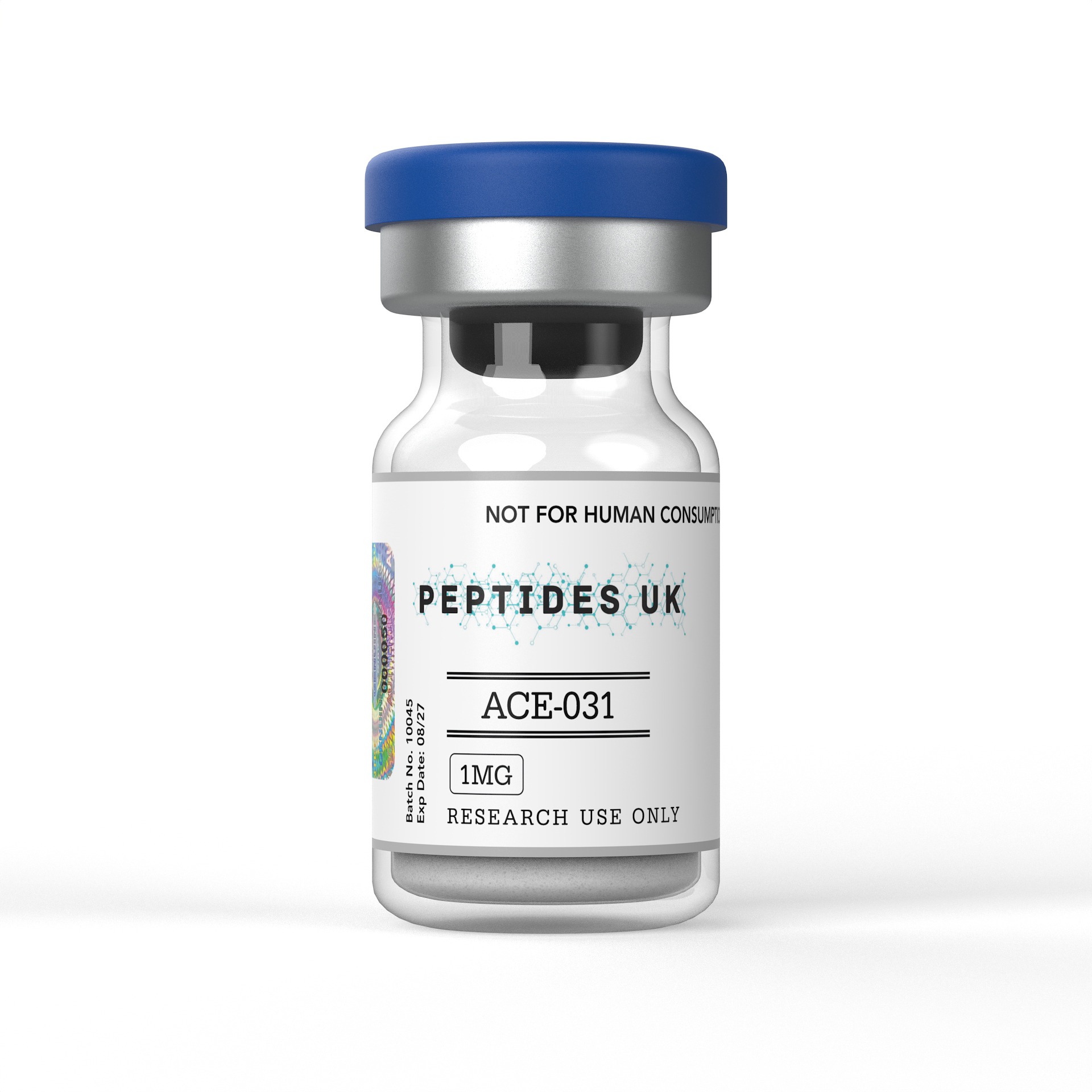
ACE-031 is a recombinant fusion protein combining the extracellular ligand-binding domain of Activin receptor type IIB (ActRIIB) with the Fc region of human IgG1 — functioning as a soluble decoy receptor that sequesters myostatin (GDF-8), activins, and related TGF-β superfamily ligands in the extracellular space, preventing their engagement with endogenous cell-surface ActRIIB and the downstream Smad2/3-dependent transcriptional programmes that suppress muscle growth, inhibit satellite cell activation, and promote proteolysis. Unlike monospecific anti-myostatin antibodies, ACE-031’s ActRIIB extracellular domain confers broad TGF-β superfamily ligand coverage — sequestering the full repertoire of ActRIIB-binding negative regulators simultaneously — making it a uniquely powerful and pharmacologically distinct tool for myostatin/activin pathway research across skeletal muscle biology, neuromuscular disease modelling, bone biology, metabolic research, and cachexia paradigms available to EU research laboratories. Research institutions and laboratories across the EU can source verified, research-grade ACE-031 in Europe with fast dispatch and full batch documentation included.
✅ ≥99% Purity — HPLC & Mass Spectrometry Verified
✅ Batch-Specific Certificate of Analysis (CoA) Included
✅ Sterile Lyophilised Powder | GMP Manufactured
✅ Fast Dispatch Across EU & Europe | EU Peptides Stock
ACE-031 — designated by Acceleron Pharma during its clinical development programme — is a recombinant fusion protein comprising the extracellular domain of the human Activin receptor type IIB (ActRIIB; encoded by ACVR2B) fused to the Fc portion of human IgG1. It is classified as a ligand trap or decoy receptor construct: a soluble, circulating form of the endogenous ActRIIB receptor that retains full ligand-binding affinity for the ActRIIB extracellular domain’s native binding partners but is no longer tethered to a transmembrane signalling complex, rendering it incapable of propagating downstream Smad2/3 activation. Instead, it competitively sequesters ActRIIB-binding ligands — including myostatin (GDF-8), activin A, activin B, GDF-11, and BMP9/10 — away from cell-surface ActRIIB, functionally depleting the bioavailable pool of these negative regulators.
The IgG1-Fc fusion element serves two engineering functions: it substantially extends the serum half-life of the construct relative to unfused receptor ectodomains through FcRn-mediated recycling (characterised half-life of 10–15 days in clinical pharmacokinetic studies), and it promotes homodimerisation of the fusion protein, producing a bivalent ligand-binding architecture with enhanced avidity for target ligands. This Fc-mediated half-life extension is a defining pharmacokinetic feature of ACE-031 relative to shorter-lived myostatin inhibitor constructs, enabling sustained pathway suppression from infrequent dosing in pre-clinical research paradigms.
ACE-031 differs fundamentally from anti-myostatin antibody inhibitors in its ligand coverage: while antibody-based inhibitors are monospecific for myostatin (GDF-8) or activin A individually, ACE-031’s ActRIIB extracellular domain captures the full spectrum of ActRIIB-binding TGF-β superfamily ligands in a single construct. This pan-ligand coverage is both the primary driver of ACE-031’s potent muscle anabolic biology and the source of its off-target vascular biology — BMP9 and BMP10, both ActRIIB-binding ligands, are critical regulators of vascular remodelling, and their incidental sequestration by ACE-031 was identified as the mechanistic basis of the epistaxis and telangiectasia adverse events observed in the DMD clinical trial, a finding that has substantially advanced the understanding of ActRIIB ligand selectivity requirements for therapeutic development and informed the design of next-generation selective inhibitors. This mechanistic history makes ACE-031 an exceptionally information-rich research tool for dissecting the individual contributions of ActRIIB-binding ligands to muscle, bone, vascular, and metabolic biology across EU research models.
In controlled laboratory and pre-clinical settings, ACE-031 is studied across the following research applications:
Skeletal Muscle Hypertrophy and Negative Regulator Biology Research — ACE-031’s primary and most extensively characterised research application is the induction of skeletal muscle hypertrophy through pan-ActRIIB ligand sequestration. Administration in murine models produces rapid and substantial muscle mass increases — driven by simultaneous removal of myostatin, activin A, activin B, and GDF-11’s constitutive suppression of muscle protein synthesis and satellite cell activation. Research uses ACE-031 to characterise the aggregate negative regulatory tone imposed by the ActRIIB ligand network on skeletal muscle mass, to establish reference hypertrophic responses against which selective inhibitors are benchmarked, and to study the relative contributions of individual ligands — myostatin versus activins — to net muscle mass suppression by comparing ACE-031 responses with monospecific antibody treatments.
Neuromuscular Disease and Muscle Wasting Model Research — ACE-031’s most clinically-motivated pre-clinical application is in neuromuscular disease models — including mdx mouse models of Duchenne muscular dystrophy, spinal muscular atrophy models, and cancer cachexia paradigms. Research has characterised ActRIIB blockade with ACE-031 and analogous constructs in dystrophic muscle — documenting increased muscle mass, reduced fibrosis, improved contractile function, and preserved ambulation metrics. In cachexia models, ACE-031 treatment has been associated with attenuation of muscle wasting, preservation of mitochondrial function, and reduction of proteolytic signalling. EU research groups use ACE-031 to study the extent to which elevated ActRIIB ligand tone contributes to pathological muscle wasting in these disease contexts, and to characterise the muscle-protective pharmacology achievable through broad ActRIIB pathway suppression.
Myostatin vs. Activin Pathway Dissection Research — A pharmacologically distinctive research application for ACE-031 is in dissecting the individual contributions of myostatin versus activin A/B to muscle mass regulation and disease pathology — by comparing ACE-031’s pan-ligand response with the responses of monospecific anti-GDF-8 antibodies or anti-activin antibodies in matched experimental paradigms. Research comparing dual anti-myostatin and anti-activin A antibody treatment with ACE-031’s ligand trap approach has established that simultaneous myostatin and activin A inhibition produces superior muscle mass gains relative to either alone — findings that have shaped the design of next-generation selective ActRIIB-pathway inhibitors. ACE-031 serves as the pan-inhibition reference condition enabling quantitative attribution of individual ligand contributions.
Bone Biology and Osteogenic Pathway Research — ACE-031 produces striking bone effects — with pre-clinical studies documenting substantial increases in femoral and vertebral bone density in treated animals, and the Phase I clinical study in postmenopausal women showing statistically significant changes in bone metabolism biomarkers alongside lean mass increases. Mechanistically, ActRIIB-binding ligands including activins and GDF-11 suppress osteoblast differentiation and bone formation — their sequestration by ACE-031 relieves this inhibition and promotes osteogenic responses. Research uses ACE-031 to study the ActRIIB ligand network’s negative regulatory role in bone mass maintenance, the muscle-bone crosstalk mechanisms linking skeletal muscle anabolic signalling to bone formation, and the TGF-β superfamily biology governing osteoporosis and sarcopenia-osteoporosis co-morbidity paradigms.
Metabolic Biology and Adipose Tissue Research — ACE-031 influences systemic metabolic biology beyond skeletal muscle — with pre-clinical models demonstrating improved lean-to-fat ratios, increased fatty acid oxidation, and improved metabolic parameters in treated animals. Myostatin-deficient models and ACE-031-treated research models tend toward reduced adiposity, increased thermogenesis, and improved insulin sensitivity — consistent with muscle mass-driven metabolic rate increases and potential direct effects of ActRIIB ligand sequestration on adipocyte biology. Research uses ACE-031 to characterise the muscle-metabolic axis and the ActRIIB pathway’s role in energy balance regulation, adipogenesis suppression, and systemic metabolic adaptation relevant to obesity and type 2 diabetes research programmes.
Cancer Cachexia and Catabolic State Research — Elevated myostatin and activin signalling have been implicated in the metabolic derailment driving cancer cachexia — contributing to muscle proteolysis, mitochondrial dysfunction, and the progressive muscle wasting characteristic of cancer-associated cachexia syndrome. Pre-clinical research using ActRIIB blockade has characterised attenuation of muscle wasting, preservation of contractile function, and improvement of survival metrics in cachectic tumour-bearing models. EU research programmes use ACE-031 to dissect the mechanistic contribution of ActRIIB ligand excess to cachexia pathophysiology and to characterise the muscle-preserving pharmacology achievable through ligand trap intervention in catabolic disease contexts.
TGF-β Superfamily Ligand Network Biology Research — ACE-031’s pan-ActRIIB ligand coverage makes it a research tool for studying the integrated biology of the ActRIIB-binding TGF-β superfamily ligand network — including myostatin, activin A, activin B, GDF-11, BMP9, and BMP10 — as a coordinated signalling system rather than individual ligand activities in isolation. Research uses ACE-031 to characterise the aggregate Smad2/3 signalling tone imposed by the full ActRIIB ligand network in specific tissue and disease contexts, to study the compensatory signalling responses to global ActRIIB ligand depletion, and to investigate ligand competition dynamics at the ActRIIB binding interface.
Vascular Biology and BMP9/10 Research — The identification of ACE-031’s incidental BMP9 and BMP10 sequestration as the mechanistic basis of its clinical vascular adverse events has established it as an important research tool for vascular biology — specifically for studying BMP9 and BMP10’s roles in endothelial homeostasis, vascular tone regulation, and arteriovenous malformation biology through the ALK1/ENG pathway. ACE-031 provides a pharmacological approach to BMP9/10 pathway suppression in vascular endothelial research models, complementing genetic approaches and enabling dose-titrated pathway modulation in vascular biology paradigms.
Reproductive Biology Research — ActRIIB is expressed in reproductive tissues including testicular germ cells and Sertoli cells — with activin signalling through ActRIIB playing characterised roles in spermatogenesis and gametogenic regulation. ACE-031’s broad activin sequestration biology makes it a research tool for investigating ActRIIB-mediated activin signalling in reproductive tissue biology — characterising the effects of ActRIIB ligand depletion on germ cell proliferation, differentiation, and the activin-regulated spermatogenic programme in pre-clinical reproductive biology models.
Phase I Clinical Pharmacology Findings — The Phase I single ascending-dose study in 48 healthy postmenopausal women established ACE-031’s clinical pharmacokinetic and pharmacodynamic profile: linear pharmacokinetics across the 0.02–3 mg/kg dose range, mean half-life of 10–15 days consistent with IgG1-Fc recycling-mediated extension, and at the 3 mg/kg dose, statistically significant increases in total body lean mass (3.3% by DXA) and thigh muscle volume (5.1% by MRI) at day 29, alongside statistically significant changes in bone and fat metabolism serum biomarkers — establishing that a single dose of a pan-ActRIIB ligand trap produced measurable pharmacodynamic muscle and bone effects in a human research cohort.
DMD Clinical Research Findings — The randomised, placebo-controlled Phase II study in ambulatory boys with Duchenne muscular dystrophy documented trends for increased lean body mass, improved bone mineral density, and maintenance of 6-minute walk test distance in ACE-031-treated subjects relative to a decline in the placebo group — pharmacodynamic findings consistent with the pre-clinical muscle and bone biology. The study was terminated following the second dosing regimen due to epistaxis and telangiectasia observations. Post-hoc mechanistic analysis identified BMP9 sequestration — rather than myostatin or activin inhibition — as the probable mechanism underlying these vascular events, a finding that substantially advanced the field’s understanding of ActRIIB ligand selectivity requirements and directly informed the design of next-generation selective inhibitor programmes.
Pre-Clinical Muscle and Bone Biology — Pre-clinical studies in mice, non-human primates, and the common marmoset have documented robust and consistent muscle mass increases, improved isometric strength, reduced muscle fibrosis in dystrophic models, and substantial bone density increases — including reported increases in femoral and vertebral density substantially exceeding those achievable with monospecific myostatin inhibition alone, consistent with activin A’s additional negative regulatory role in bone biology. Marmoset studies employing 14-week ACE-031 dosing regimens have characterised muscle fibre morphology, isometric strength, and body composition outcomes — providing non-human primate data supporting the translational relevance of the pre-clinical muscle biology to higher-order research models.
| Feature | ACE-031 |
|---|---|
| Construct Type | Recombinant Fusion Protein — ActRIIB Extracellular Domain + IgG1-Fc |
| Also Known As | ActRIIB-Fc / Soluble ActRIIB / ACVR2B-Fc |
| Developer | Acceleron Pharma (clinical development programme) |
| Primary Ligands Sequestered | Myostatin (GDF-8), Activin A, Activin B, GDF-11, BMP9, BMP10 |
| Mechanism | Extracellular decoy receptor — competitive ligand sequestration; prevents ActRIIB/Smad2/3 pathway activation |
| Selectivity Profile | Pan-ActRIIB-binding ligand coverage — not monospecific for myostatin |
| Half-Life | ~10–15 days (FcRn-mediated IgG1-Fc recycling) |
| Skeletal Muscle Biology | Hypertrophy induction; satellite cell activation; suppression of proteolytic programme |
| Bone Biology | Osteogenic — increased femoral and vertebral density in pre-clinical models; activin/GDF-11 sequestration |
| Metabolic Biology | Improved lean/fat ratio; fatty acid oxidation; metabolic rate modulation |
| Cardiac Biology | Indirect via Smad2/3 pathway modulation; cardiac fibrosis attenuation in disease models |
| Vascular Biology | BMP9/BMP10 sequestration → ALK1/ENG pathway suppression → epistaxis/telangiectasia relevance |
| Clinical Programme | Phase I (healthy postmenopausal women) + Phase II (DMD) — development discontinued |
| Reason for Discontinuation | BMP9-mediated vascular adverse events (epistaxis, telangiectasia) |
| Research Utility | Pan-ligand reference condition; ligand contribution dissection; NMD model; bone/metabolic biology |
| Comparator Value | Benchmarks selective inhibitors; distinguishes myostatin vs. activin vs. BMP contributions |
| Parameter | Specification |
|---|---|
| Full Name | ACE-031 / ActRIIB-Fc Fusion Protein / Soluble Activin Receptor Type IIB |
| Also Known As | ActRIIB-Fc / ACVR2B-Fc / Soluble ActRIIB |
| Construct Type | Recombinant Fusion Protein — Human ActRIIB Extracellular Domain (aa 19–134) fused to Human IgG1-Fc |
| Protein Family | TGF-β Superfamily Ligand Trap — Decoy Receptor Construct |
| Molecular Weight | ~60–65 kDa (glycosylated homodimer; ~28–30 kDa per monomer) |
| Expressed Region | ActRIIB extracellular domain (ligand-binding region) + IgG1-Fc (hinge-CH2-CH3) |
| Fc Domain | Human IgG1-Fc — homodimerisation + FcRn-mediated half-life extension |
| Primary Ligands | Myostatin (GDF-8), Activin A, Activin B, GDF-11, BMP9, BMP10 |
| Mechanism | Competitive extracellular ligand sequestration — decoy receptor; blocks Smad2/3 pathway activation |
| Purity | ≥99% HPLC & SDS-PAGE Verified |
| Endotoxin | <1.0 EU/µg |
| Form | Sterile Lyophilised Powder |
| Formulation | PBS-based buffer, pH 7.2–7.4; carrier protein-free — see CoA for batch specification |
| Solubility | Reconstitute in sterile PBS at the concentration specified on the batch CoA |
| Storage (Powder) | -20°C or -80°C (recommended for long-term); protect from moisture; avoid repeated freeze-thaw |
| Storage (Reconstituted) | -80°C single-use aliquots; minimise freeze-thaw cycles |
| Working Concentration | Typically 0.1–10 µg/mL in cell-based Smad2/3 inhibition assays — empirically optimise per assay system |
| Vial Size | 1mg |
ACE-031 reconstitutes in sterile PBS at the concentration specified on the batch-specific CoA — add PBS slowly to the lyophilised powder and swirl gently without vortexing to dissolve. ACE-031 is an IgG1-Fc fusion protein and should be handled with the same care applied to therapeutic antibody preparations: avoid vigorous agitation, foaming, and repeated freeze-thaw cycles, all of which promote aggregation and activity loss for Fc fusion proteins.
The IgG1-Fc domain confers inherent solution stability relative to unfused receptor ectodomains — ACE-031 reconstitutes readily under gentle aqueous conditions and does not require acidic reconstitution. The construct contains disulphide bonds — both within the IgG1-Fc CH2-CH3 domains and within the ActRIIB extracellular domain — and must not be exposed to reducing agents (DTT, BME, TCEP) at any stage; reducing conditions will disrupt the disulphide architecture essential for correct fold, homodimerisation, and ligand-binding activity.
Prepare single-use working aliquots and store at -80°C following reconstitution. Protein-low-binding tubes and pipette tips are recommended for all handling — Fc fusion proteins are susceptible to adsorptive losses at low working concentrations, particularly in the sub-µg/mL range relevant to cell-based assays. For Smad2/3 inhibition assays, pre-incubate ACE-031 with the target ligand (e.g. GDF-8 or activin A) for 30–60 minutes before addition to cells to ensure ligand sequestration is complete before receptor engagement.
| Feature | ACE-031 (ActRIIB-Fc) | Anti-GDF-8 Antibody | Anti-Activin A Antibody |
|---|---|---|---|
| Ligand Coverage | Pan-ActRIIB: GDF-8 + Activin A/B + GDF-11 + BMP9/10 | GDF-8 (Myostatin) only | Activin A only |
| Muscle Biology | Maximum — all negative regulators simultaneously | Partial — myostatin alone | Partial — activin A alone |
| Bone Biology | Robust — activin/GDF-11 + myostatin sequestration | Limited — myostatin alone | Moderate — activin A contributes |
| Vascular Biology | BMP9/BMP10 off-target engagement | No BMP9/BMP10 activity | No BMP9/BMP10 activity |
| Research Utility | Pan-inhibition reference; maximum pathway suppression | Myostatin-specific attribution | Activin A-specific attribution |
| Dissection Value | Establishes ceiling; compare vs. monospecific for attribution | Quantifies myostatin contribution | Quantifies activin A contribution |
| Half-Life | ~10–15 days (FcRn recycling) | Variable — antibody-dependent | Variable — antibody-dependent |
| Selectivity | Broad — all ActRIIB-binding ligands | Narrow — GDF-8 monospecific | Narrow — activin A monospecific |
Every ACE-031 order dispatched across the EU and Europe includes:
✅ Batch-Specific Certificate of Analysis (CoA)
✅ HPLC Chromatogram and SDS-PAGE Verification
✅ Mass Spectrometry Confirmation — molecular weight and identity verification
✅ Endotoxin Testing Report (<1.0 EU/µg)
✅ Biological Activity Report — EC50 in GDF-8 or Activin A-induced Smad2/3 inhibition assay
✅ Reconstitution Protocol
✅ Technical Research Support
Yes — research-grade ACE-031 (ActRIIB-Fc fusion protein) is available to researchers and institutions across the EU and Europe with fast dispatch and full batch documentation included. Supplied strictly for laboratory research purposes only.
Anti-myostatin antibodies are monospecific — they bind and neutralise GDF-8 (myostatin) alone. ACE-031’s ActRIIB extracellular domain binds the full repertoire of ActRIIB-interacting TGF-β superfamily ligands — including myostatin, activin A, activin B, GDF-11, BMP9, and BMP10 — simultaneously. This pan-ligand coverage produces substantially greater muscle and bone effects than monospecific myostatin inhibition alone, as activin A makes an independent and additive contribution to muscle mass suppression through the same ActRIIB/Smad2/3 pathway. The trade-off is that ACE-031’s broader coverage also sequesters BMP9 and BMP10 — vascular biology regulators — creating off-target vascular biology absent from monospecific myostatin antibody treatments. This distinction is the central mechanistic rationale for using both ACE-031 and monospecific antibodies in matched experimental paradigms.
The DMD Phase II trial was discontinued following the second dosing regimen due to epistaxis and telangiectasia observations in ACE-031-treated subjects. Post-hoc mechanistic investigation identified incidental sequestration of BMP9 — an ActRIIB-binding ligand that signals through ALK1 and endoglin (ENG) to maintain vascular endothelial homeostasis — as the probable mechanistic basis of the vascular adverse events. This finding was not indicative of failure of the myostatin inhibition hypothesis — the pharmacodynamic trends for lean mass and ambulation were consistent with the biology — but rather established that pan-ActRIIB ligand coverage requires BMP9/BMP10 selectivity exclusion for safe clinical application. This mechanistic discovery directly informed the design of next-generation selective ActRIIB-pathway inhibitors that retain myostatin and activin A coverage while sparing BMP9/BMP10.
ACE-031’s ActRIIB extracellular domain binds: Myostatin (GDF-8), Activin A, Activin B, GDF-11, BMP9, and BMP10 — all members of the TGF-β superfamily that bind ActRIIB with varying affinities. Myostatin and activin A are the primary muscle-regulatory ligands. GDF-11 contributes to age-related muscle and bone biology. BMP9 and BMP10 are the vascular biology-relevant off-target ligands responsible for ACE-031’s vascular pharmacology.
Reconstitute in sterile PBS at the concentration specified on the batch-specific CoA. Do not use acidic reconstitution buffers — unlike carrier-free recombinant ligands, the IgG1-Fc fusion architecture of ACE-031 is stable under neutral aqueous conditions. Do not use reducing agents at any stage. Swirl gently without vortexing. Prepare single-use aliquots and store at -80°C. See the included reconstitution protocol for precise batch-specific instructions.
Vehicle control (matched PBS concentration) is required. Ligand-alone controls — GDF-8, activin A, or other target ligands — at matched concentrations establish reference agonist responses. For ligand contribution dissection experiments, matched concentrations of monospecific anti-GDF-8 and anti-activin A antibody controls alongside ACE-031 allow quantitative attribution of individual ligand contributions to combined pathway biology. Smad2/3 phosphorylation positive controls (e.g. TGF-β1) allow pathway activation cross-validation.
In cell-based Smad2/3 inhibition assays — pre-incubating ACE-031 with GDF-8 or activin A before addition to responsive cell lines — working concentrations in the 0.1–10 µg/mL range are typical. Molar excess of ACE-031 relative to the target ligand is required for effective sequestration; the degree of excess should be determined empirically based on the ligand concentration used in the specific assay. The batch-specific biological activity report provides the EC50 for inhibition of GDF-8-induced Smad2/3 phosphorylation for each ACE-031 lot dispatched to EU laboratories.
≥99% purity by HPLC and SDS-PAGE verification is essential — aggregated or misfolded Fc fusion protein contaminants would produce artificially reduced apparent potency in ligand sequestration assays and could introduce non-specific cell biology confounds. Endotoxin below 1.0 EU/µg is required to exclude LPS-attributable NF-κB-driven inflammatory signalling confounds in cell-based assays. Both purity and endotoxin are independently verified for each ACE-031 batch before dispatch to European research laboratories.
ACE-031 (ActRIIB-Fc Fusion Protein) is supplied exclusively for legitimate scientific research purposes conducted within licensed laboratory environments across the EU and Europe. This product is not intended for human consumption, self-administration, or any therapeutic application. It must be handled by qualified researchers in compliance with applicable EU regulations and institutional biosafety guidelines. By purchasing, you confirm that this compound will be used solely for approved in vitro or pre-clinical research purposes.


WhatsApp us
Receive News
