PRODUCTS SOLD ON PEPTIDESLABEU.COM ARE FOR RESEARCH PURPOSES ONLY AND ARE NOT FOR HUMAN OR VETERINARY USE.
€150.00
Cerebrolysin EU – Buy Online | In Stock & Ready to Ship
Buy Cerebrolysin in Europe with fast shipping and guaranteed ≥99% purity — verified with COA and HPLC documentation. A trusted choice for peptides EU research teams rely on, with no customs delays or lengthy international wait times. Whether you’re searching for Cerebrolysin Europe suppliers, looking to buy Cerebrolysin in the EU, or sourcing peptides Europe-wide, we have you covered. Research teams across the EU can count on consistent stock, rapid fulfilment and full batch documentation every time.
For research use only. Not intended for human or veterinary use.


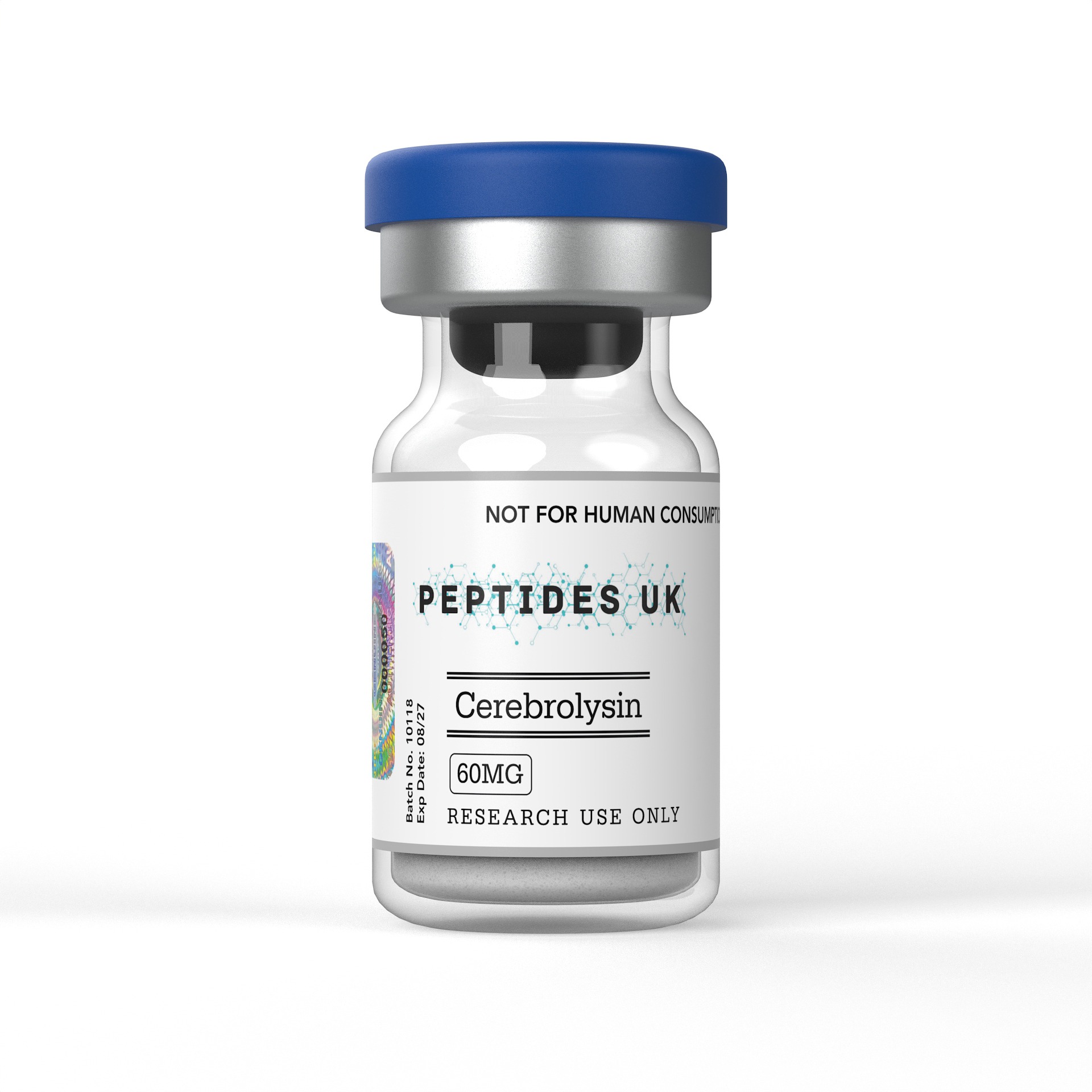
Cerebrolysin is a standardised peptide mixture derived from purified porcine brain protein, available to buy in Europe for laboratory research into neuroprotection, neurotrophic factor biology, neuroplasticity, cognitive function, and the mechanisms of peptide-mediated central nervous system repair and regeneration.
Laboratories and research institutions across the EU can order verified, research-grade Cerebrolysin with fast international dispatch to Europe, full batch documentation, and verified purity confirmed by analytical testing.
✅ Verified Purity — Analytically Tested
✅ Batch-Specific Certificate of Analysis (CoA)
✅ Sterile Solution | GMP Manufactured
✅ Fast Dispatch to EU & Europe | Tracked Shipping
Cerebrolysin is a standardised neuropeptide mixture produced through controlled enzymatic digestion of purified porcine brain proteins — yielding a defined preparation comprising approximately 25% low molecular weight peptides and amino acids, with the remaining 75% consisting of free amino acids. The active peptide fraction — peptides below 10,000 daltons that are capable of crossing the blood-brain barrier — is considered responsible for Cerebrolysin’s neurotrophic and neuroprotective biological activities, which have been characterised across decades of pre-clinical and clinical research as closely resembling the combined effects of endogenous neurotrophic factors including BDNF, NGF, NT-3, and CNTF.
First developed in Austria in the 1950s and subsequently the subject of extensive pre-clinical and clinical investigation — particularly across Central and Eastern Europe, Asia, and Russia — Cerebrolysin has accumulated one of the largest research literatures of any neuropeptide preparation, with studies spanning stroke recovery, Alzheimer’s disease, traumatic brain injury, vascular dementia, and a broad range of neurodegenerative and neurodevelopmental research applications. Its multi-component peptide composition produces a biological profile that individual single-peptide neurotrophic compounds cannot replicate — simultaneously engaging multiple neurotrophic signalling pathways, metabolic support mechanisms, and neuroprotective cascades in a coordinated manner that reflects its origin from brain tissue.
Cerebrolysin’s mechanism of action is characterised by its neurotrophic factor-like activity — stimulating the same intracellular signalling pathways activated by BDNF, NGF, and related endogenous neurotrophins without being identical to any single neurotrophin. This multimodal neurotrophic profile, combined with its well-documented ability to cross the blood-brain barrier following systemic administration, has made Cerebrolysin a widely used research tool for studying peptide-mediated neuroprotection, neuroplasticity, and CNS repair mechanisms in European pre-clinical research settings.
In laboratory settings, Cerebrolysin is studied as a multimodal neurotrophic peptide mixture with broad CNS biological activity. EU and European researchers working with Cerebrolysin typically focus on:
All research applications are for in vitro and pre-clinical use only.
Cerebrolysin has one of the most extensive research literatures of any neuropeptide preparation — with decades of pre-clinical and clinical investigation establishing its neurotrophic, neuroprotective, and neuroplasticity-promoting biological profile across multiple CNS disease models and research applications.
Neurotrophic factor-like activity characterisation: Foundational studies characterising Cerebrolysin’s mechanism of action documented its ability to activate neurotrophin receptor signalling — including TrkB phosphorylation and downstream PI3K/Akt and MAPK/ERK pathway activation — in a manner resembling BDNF and NGF without being identical to either. These mechanistic studies established Cerebrolysin’s neurotrophic factor-like activity as the primary basis for its biological effects and positioned it as a research tool for studying multimodal neurotrophin signalling.
Ischaemia and stroke research: A large body of pre-clinical studies has documented Cerebrolysin’s neuroprotective effects in cerebral ischaemia models — with findings across multiple rodent ischaemia model systems consistently showing reductions in infarct volume, improved neurological deficit scores, and enhanced functional recovery. Meta-analyses of pre-clinical stroke studies have supported the consistency of these findings across research groups and model systems.
Alzheimer’s disease research: Studies examining Cerebrolysin in Alzheimer’s disease models have documented effects on multiple pathological processes — including reduced amyloid beta production through APP processing modulation, decreased tau phosphorylation, preservation of synaptic density, and maintenance of cholinergic neuron function. These multi-target effects in Alzheimer’s models reflect Cerebrolysin’s multimodal biology and have driven sustained research interest in its application to Alzheimer’s disease biology.
Cognitive and memory findings: Pre-clinical studies have consistently documented Cerebrolysin-associated improvements in cognitive performance across multiple rodent learning and memory paradigms — including Morris water maze spatial learning, passive avoidance, and novel object recognition. These cognitive findings have been documented in both normal animals and disease models — contributing to understanding of how neurotrophic factor-like signalling influences cognitive biology.
Neurogenesis findings: Studies documenting Cerebrolysin-enhanced adult hippocampal neurogenesis have characterised increased BrdU incorporation, doublecortin-positive cell numbers, and NeuN-positive mature neuron survival in the dentate gyrus of treated animals — with findings suggesting that Cerebrolysin’s neurotrophic activity includes promotion of adult neurogenic processes relevant to hippocampal function and plasticity.
Traumatic brain injury research: Studies examining Cerebrolysin in experimental TBI models have documented neuroprotective effects on neuronal survival, reduced oedema parameters, promotion of axonal sprouting and circuit reorganisation, and improvements in cognitive and motor recovery scores — contributing to understanding of how neurotrophic peptide mixtures support CNS recovery following traumatic injury.
Clinical research base: Unusually for a research peptide preparation, Cerebrolysin has been the subject of numerous clinical trials — particularly in stroke recovery, Alzheimer’s disease, and vascular dementia — primarily conducted in European, Russian, and Asian research centres. This clinical research base provides translational context for the pre-clinical findings and has established Cerebrolysin as one of the most clinically investigated neuropeptide preparations available as a research tool.
| Compound | Type | Primary Mechanism | Key Research Application |
|---|---|---|---|
| Cerebrolysin | Standardised porcine brain peptide mixture | Multimodal neurotrophic factor-like activity — BDNF/NGF pathway activation | Neuroprotection, stroke, Alzheimer’s, neuroplasticity, cognitive research |
| BDNF | Endogenous neurotrophin | TrkB receptor agonism | Reference neurotrophin — synaptic plasticity, neuronal survival |
| NGF | Endogenous neurotrophin | TrkA receptor agonism | Cholinergic neuron biology, peripheral nerve research |
| Semax | ACTH(4-10) heptapeptide | BDNF/NGF upregulation | Neuroprotection, cognitive biology — single peptide |
| P21 | Enhanced Humanin analogue | CNTFR/JAK/STAT3 activation | Neurogenesis, hippocampal biology, neuroprotection |
| Dihexa | HGF/MET pathway agonist | MET receptor activation | Synaptogenesis, cognitive biology, neurogenesis |
Every order of Cerebrolysin dispatched to EU and European research institutions includes:
Yes. We supply research-grade Cerebrolysin with fast tracked international dispatch to all EU member states and wider European destinations including Germany, France, Netherlands, Spain, Italy, Poland, and beyond. All orders include full batch documentation and packaging designed to maintain preparation integrity throughout transit. Cerebrolysin is supplied strictly for laboratory research use only.
Cerebrolysin comprises approximately 25% low molecular weight peptides and amino acids — the biologically active fraction — with the remaining 75% consisting of free amino acids. The active peptide fraction consists of peptides below 10,000 daltons that are capable of crossing the blood-brain barrier following systemic administration. This peptide fraction is considered responsible for Cerebrolysin’s neurotrophic and neuroprotective biological activities — activating neurotrophin receptor signalling pathways in a manner resembling the combined activity of BDNF, NGF, NT-3, and CNTF. The specific peptide components of the active fraction have been partially characterised but the full peptide composition reflects the complexity of the porcine brain protein source and enzymatic digestion process.
Recombinant BDNF is a single defined protein that activates the TrkB receptor with high specificity — making it the reference tool for studying TrkB-mediated signalling in isolation. Cerebrolysin is a multicomponent peptide mixture that activates multiple neurotrophin receptor pathways simultaneously — producing a biological profile that resembles the combined activity of several neurotrophins rather than any single factor. This multimodal activity profile is considered both a research advantage — providing simultaneous engagement of multiple neuroprotective and plasticity-promoting pathways — and a research consideration, as the multi-component nature makes mechanistic attribution more complex than with single recombinant factors. The two are studied as complementary tools for examining single-pathway versus multimodal neurotrophin biology.
Studies examining Cerebrolysin’s CNS bioavailability have documented that its low molecular weight peptide fraction — the biologically active component — crosses the blood-brain barrier following systemic administration in animal models. Evidence includes detection of Cerebrolysin-associated peptides in cerebrospinal fluid following systemic administration, demonstration of CNS pharmacological effects following intravenous administration that are consistent with direct CNS activity, and in vitro studies documenting transcytosis of Cerebrolysin peptide components across brain endothelial cell models. The molecular weight threshold of the active peptide fraction — below 10,000 daltons, with many active components substantially smaller — is consistent with blood-brain barrier penetration through established peptide transport mechanisms.
Alzheimer’s disease pathology involves multiple parallel degenerative processes — including amyloid beta accumulation, tau hyperphosphorylation, synaptic loss, cholinergic neuron degeneration, and neuroinflammation — that converge to produce progressive neurodegeneration and cognitive decline. Single-target interventions addressing only one of these processes have shown limited efficacy in translational research. Cerebrolysin’s multimodal neurotrophic activity addresses several of these pathological processes simultaneously — with studies documenting effects on APP processing, tau phosphorylation, synaptic density preservation, and cholinergic neuron survival in Alzheimer’s models. This multi-target profile makes Cerebrolysin a research tool of particular interest for studying how coordinated neurotrophic support influences the multi-factorial pathological processes of Alzheimer’s disease biology.
Studies have documented Cerebrolysin-enhanced adult hippocampal neurogenesis — with findings showing increased neural progenitor cell proliferation and survival of newly generated neurons in the dentate gyrus of treated animals. These neurogenesis-promoting effects are consistent with Cerebrolysin’s activation of BDNF/TrkB and related neurotrophin signalling pathways — which are well-established regulators of adult neurogenic processes. The neurogenesis findings connect Cerebrolysin’s neurotrophic biology to hippocampal plasticity and cognitive function research — and position it as a research tool for studying how multimodal neurotrophin-like signalling influences adult neurogenic processes relevant to both normal cognitive function and post-injury brain repair.
Cerebrolysin is supplied as a sterile solution. Store at 2–8°C protected from light — do not freeze as freezing may alter the peptide mixture composition and biological activity profile. Allow to reach room temperature before use and mix gently without shaking. Prepare working dilutions in appropriate sterile laboratory buffers or cell culture media as required by your research protocol. As with all biological peptide preparations, standard aseptic technique should be applied during handling to maintain sterility. Refer to the included handling protocol for specific storage and preparation guidance.
Orders are dispatched promptly via tracked international courier with appropriate temperature-controlled packaging. Delivery to EU and European destinations typically takes 3–7 working days depending on location, with cold-chain packaging designed to maintain preparation integrity throughout transit.
| Parameter | Detail |
|---|---|
| Type | Standardised Porcine Brain Neuropeptide Mixture |
| Composition | ~25% low MW peptides and amino acids / ~75% free amino acids |
| Active Fraction | Peptides below 10,000 daltons — BBB penetrant |
| Primary Mechanism | Multimodal neurotrophic factor-like activity — BDNF/NGF pathway activation |
| Primary Research Interest | Neuroprotection, stroke, Alzheimer’s, neuroplasticity, cognitive biology |
| Purity | Verified by analytical testing |
| Form | Sterile Solution |
| Storage | 2–8°C, protected from light — do not freeze |
| Intended Use | Research use only |
Cerebrolysin is supplied exclusively for legitimate scientific research conducted within licensed laboratory environments. This product is not approved for human consumption, self-administration, or any therapeutic, clinical, or veterinary application. It must be handled solely by qualified researchers in compliance with applicable EU regulations, national legislation, and institutional ethics guidelines. By purchasing, you confirm this compound will be used exclusively for approved in vitro or pre-clinical research purposes.

WhatsApp us
Receive News
