PRODUCTS SOLD ON PEPTIDESLABEU.COM ARE FOR RESEARCH PURPOSES ONLY AND ARE NOT FOR HUMAN OR VETERINARY USE.
€45.50
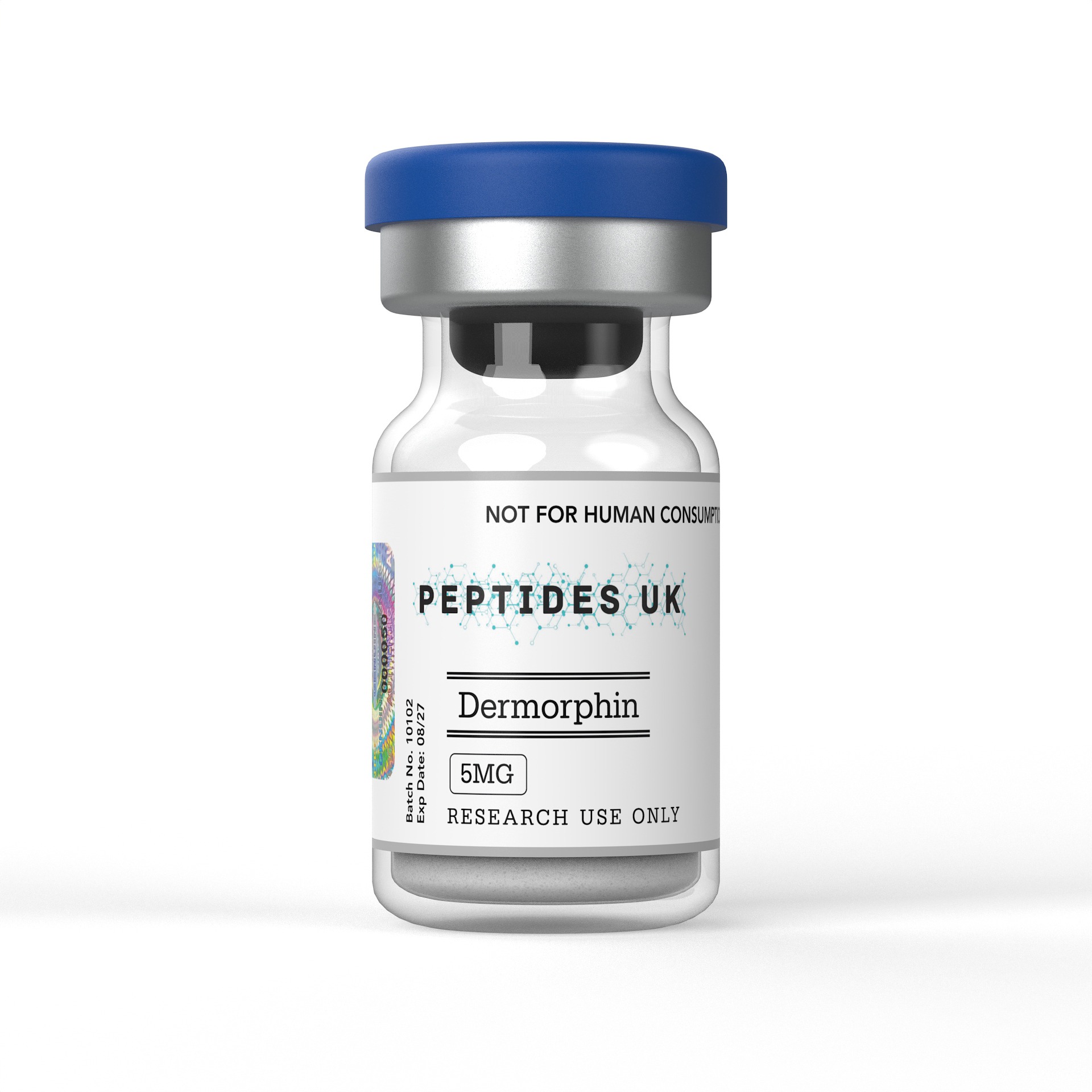
Dermorphin EU – Buy Online | In Stock & Ready to Ship
Buy Dermorphin in Europe with fast shipping and guaranteed ≥99% purity — verified with COA and HPLC documentation. A trusted choice for peptides EU research teams rely on, with no customs delays or lengthy international wait times. Whether you’re searching for Dermorphin Europe suppliers, looking to buy Dermorphin in the EU, or sourcing peptides Europe-wide, we have you covered. Research teams across the EU can count on consistent stock, rapid fulfilment and full batch documentation every time.
For research use only. Not intended for human or veterinary use.



Dermorphin is a naturally occurring heptapeptide opioid isolated from the skin of South American frogs of the Phyllomedusa genus, available to buy in Europe for laboratory research into opioid receptor pharmacology, mu-opioid receptor biology, pain signalling mechanisms, and the structure-activity relationships of peptide opioid ligands.
Laboratories and research institutions across the EU can order verified, research-grade Dermorphin with fast international dispatch to Europe, full batch documentation, and ≥99% purity confirmed by HPLC and Mass Spectrometry.
✅ ≥99% Purity — HPLC & Mass Spectrometry Verified
✅ Batch-Specific Certificate of Analysis (CoA)
✅ Sterile Lyophilised Powder | GMP Manufactured
✅ Fast Dispatch to EU & Europe | Tracked Shipping
Dermorphin is a naturally occurring heptapeptide — sequence Tyr-D-Ala-Phe-Gly-Tyr-Pro-Ser-NH2 — first isolated in 1981 by Vittorio Erspamer and colleagues from the skin secretions of the South American tree frog Phyllomedusa sauvagei. Its discovery was immediately significant for two reasons: it was the first naturally occurring peptide found to contain a D-amino acid (D-alanine at position 2) in an animal — rather than bacterial — source, and it demonstrated opioid receptor binding affinity and selectivity vastly exceeding that of morphine — establishing dermorphin as one of the most potent naturally occurring mu-opioid receptor (MOR) agonist peptides ever characterised.
The presence of D-alanine at position 2 — an unusual feature for an animal peptide, as most biological peptides are composed exclusively of L-amino acids — is essential for dermorphin’s exceptional mu-opioid receptor affinity and its resistance to enzymatic degradation compared to L-amino acid peptides. This D-amino acid incorporation is now understood to reflect a post-translational isomerisation process in Phyllomedusa skin glands — an extraordinary biological mechanism that produces a peptide with pharmacological properties qualitatively different from anything achievable with standard L-amino acid composition alone.
Dermorphin’s exceptional MOR selectivity — binding mu-opioid receptors with approximately 1000-fold greater affinity than morphine and with high selectivity over delta and kappa opioid receptor subtypes — has made it one of the most important reference ligands in opioid receptor pharmacology research. Its well-characterised receptor binding profile, peptide structure amenable to systematic modification, and natural origin as a skin defence peptide have established dermorphin as a foundational tool in opioid receptor biology, peptide analgesic research, and the medicinal chemistry of opioid peptide ligands — making it a compound of enduring research interest in European pharmacology and neuroscience laboratories.
In laboratory settings, dermorphin is studied primarily as a highly selective mu-opioid receptor agonist and reference pharmacological tool, with research applications centred on opioid receptor biology, pain signalling, and peptide opioid medicinal chemistry. EU and European researchers working with dermorphin typically focus on:
All research applications are for in vitro and pre-clinical use only.
Dermorphin has an extensive and well-characterised research literature spanning over four decades — with studies establishing its foundational importance in opioid receptor pharmacology, peptide opioid medicinal chemistry, and pain signalling research.
Discovery and receptor characterisation: Erspamer’s 1981 discovery of dermorphin was immediately followed by studies characterising its extraordinary mu-opioid receptor affinity — with binding assays documenting MOR affinity approximately 1000-fold greater than morphine and high selectivity over delta and kappa opioid receptors. These foundational pharmacological characterisations established dermorphin as the reference high-affinity MOR peptide agonist and triggered decades of subsequent research into its structure-activity relationships and pharmacological applications.
D-amino acid significance: Studies examining the importance of D-alanine at position 2 for dermorphin’s pharmacological profile have documented that replacement with L-alanine dramatically reduces MOR affinity and antinociceptive potency — establishing the D-amino acid as essential for the receptor binding geometry producing dermorphin’s exceptional MOR engagement. This finding has had broad implications for peptide medicinal chemistry — establishing D-amino acid incorporation as a validated strategy for optimising opioid peptide receptor affinity and metabolic stability.
Antinociception research: Pre-clinical studies have consistently documented dermorphin’s potent antinociceptive effects across multiple pain model systems — including hot plate, tail flick, formalin, and writhing assays — with findings establishing its antinociceptive potency significantly exceeding that of morphine on a molar basis. Studies examining spinal versus supraspinal administration have characterised the site-specific contributions of MOR activation to dermorphin’s overall antinociceptive profile.
Structure-activity relationship research: Dermorphin has served as one of the primary scaffolds for systematic peptide opioid SAR research — with studies examining hundreds of analogues incorporating amino acid substitutions, truncations, cyclisations, and D-amino acid variations to characterise the structural requirements for MOR affinity, selectivity, and functional activity. This SAR literature has contributed foundational knowledge to opioid peptide medicinal chemistry and has informed the design of novel opioid research tools.
Receptor internalisation and tolerance studies: Studies examining dermorphin-induced MOR internalisation and tolerance have characterised the cellular dynamics of MOR trafficking — documenting agonist-driven receptor internalisation, intracellular trafficking, and recycling patterns that influence opioid receptor resensitisation and the development of tolerance to repeated opioid exposure.
Signalling pathway characterisation: Research has characterised dermorphin’s downstream MOR signalling — documenting Gi/o coupling, adenylyl cyclase inhibition, GIRK channel activation, and calcium channel modulation in MOR-expressing cell systems. These signalling characterisations have contributed to the broader literature on MOR signal transduction and how agonist pharmacological properties influence the balance of G-protein versus arrestin pathway engagement.
Comparative amphibian peptide research: Studies examining dermorphin alongside other Phyllomedusa skin peptides have contributed to understanding of how this frog genus has evolved a remarkably diverse pharmacopoeia of bioactive peptides targeting mammalian receptor systems — including opioid receptors (dermorphin, deltorphins), neurotensin receptors (phyllocaerulein), and CRH receptors (sauvagine) — providing insights into the evolutionary convergence of amphibian defensive chemistry and mammalian neuropeptide receptor biology.
| Compound | Type | Receptor Selectivity | Key Research Application |
|---|---|---|---|
| Dermorphin | Natural heptapeptide — D-Ala2 | MOR highly selective — very high affinity | Reference MOR peptide agonist, SAR scaffold, antinociception research |
| DAMGO | Synthetic enkephalin analogue | MOR selective | Standard MOR reference agonist — binding assays, signalling research |
| Morphine | Alkaloid opioid | MOR preferring — some KOR | Reference non-peptide MOR agonist, tolerance/dependence models |
| Deltorphin I/II | Phyllomedusa skin peptides | DOR highly selective | Reference delta-opioid receptor peptide agonists — comparative opioid research |
| DPDPE | Synthetic enkephalin analogue | DOR selective | Delta-opioid receptor pharmacology reference |
| Endomorphin-1/2 | Endogenous tetrapeptides | MOR selective | Endogenous MOR ligand biology, comparative peptide opioid research |
Every order of Dermorphin peptide dispatched to EU and European research institutions includes:
Yes. We supply research-grade Dermorphin with fast tracked international dispatch to all EU member states and wider European destinations including Germany, France, Netherlands, Spain, Italy, Poland, and beyond. Packaging is designed to maintain peptide integrity throughout transit and all orders include full batch documentation. Dermorphin is supplied strictly for laboratory research use only and must be handled in compliance with applicable national regulations governing opioid research compounds.
Dermorphin’s exceptional mu-opioid receptor affinity — approximately 1000-fold greater than morphine — results from the combination of its D-alanine at position 2 and the overall heptapeptide sequence geometry that produces near-optimal engagement with the MOR binding pocket. The D-alanine substitution constrains the peptide backbone conformation at position 2 to a geometry that places the downstream pharmacophore elements — particularly the Phe3 aromatic ring and the Tyr1 hydroxyl group — in the precise spatial arrangement required for high-affinity MOR engagement. Additionally, D-amino acid incorporation protects the peptide from dipeptidyl peptidase cleavage at the N-terminal Tyr-D-Ala bond — extending its biological activity window in research systems. The combination of optimal receptor binding geometry and improved enzymatic stability distinguishes dermorphin’s pharmacological profile from both morphine and L-amino acid opioid peptides.
The D-alanine at position 2 of dermorphin is one of the most pharmacologically significant D-amino acid residues identified in any naturally occurring animal peptide — and its discovery in dermorphin in 1981 fundamentally influenced peptide medicinal chemistry. Prior to dermorphin’s discovery, D-amino acids in animal peptides were essentially unknown — their presence was considered a bacterial or fungal characteristic. Dermorphin demonstrated that animal biosynthetic machinery could produce D-amino acid-containing peptides through post-translational isomerisation, and that D-amino acid incorporation could dramatically enhance peptide receptor pharmacology. This discovery triggered systematic investigation of D-amino acid incorporation as a medicinal chemistry strategy — influencing the design of research peptides and drug candidates across multiple receptor classes beyond opioids.
Dermorphin and the deltorphins are both naturally occurring D-amino acid-containing opioid peptides from Phyllomedusa frog skin — but with complementary receptor selectivity profiles that make them equally important but distinct research tools. Dermorphin is highly selective for mu-opioid receptors — making it the reference tool for MOR pharmacology research. Deltorphins (deltorphin I: Tyr-D-Ala-Phe-Asp-Val-Val-Gly-NH2 and deltorphin II: Tyr-D-Ala-Phe-Glu-Val-Val-Gly-NH2) are highly selective for delta-opioid receptors — making them the reference tools for DOR pharmacology research. The two peptide families are studied as complementary tools enabling pharmacological dissection of MOR versus DOR contributions to opioid system biology.
Both dermorphin and DAMGO (D-Ala2-MePhe4-Gly-ol5 enkephalin) are widely used as reference MOR agonist research tools, but they differ in origin, structure, and specific research applications. DAMGO is a synthetic enkephalin analogue designed specifically as a selective MOR research tool — widely used in radioligand binding assays and signalling studies as the standard MOR reference agonist. Dermorphin is a naturally occurring heptapeptide with a distinct structural scaffold — providing a different molecular geometry for receptor engagement and serving as both a pharmacological tool and a medicinal chemistry scaffold for SAR research. The two compounds are complementary reference ligands used in parallel in MOR pharmacology research to confirm receptor selectivity and compare agonist properties.
Allow the vial to reach room temperature before opening. Add sterile water or an appropriate laboratory buffer slowly down the vial wall and swirl gently — do not shake. Dermorphin is soluble in aqueous buffers — prepare at your protocol’s required concentration, aliquot, and store at -80°C to minimise freeze-thaw degradation. The D-alanine at position 2 confers improved enzymatic stability compared to all-L-amino acid opioid peptides — but standard peptide handling protocols should be followed to maintain biological activity. Prepare working solutions fresh where possible and handle on ice during experimental procedures.
Orders are dispatched promptly via tracked international courier. Delivery to EU and European destinations typically takes 3–7 working days depending on location, with packaging designed to protect peptide stability throughout transit.
| Parameter | Detail |
|---|---|
| Sequence | Tyr-D-Ala-Phe-Gly-Tyr-Pro-Ser-NH2 |
| Type | Naturally Occurring Heptapeptide Opioid — D-Amino Acid Containing |
| Source Origin | Phyllomedusa sauvagei frog skin secretion |
| Primary Receptor | Mu-Opioid Receptor (MOR) — highly selective, very high affinity |
| Key Structural Feature | D-Alanine at position 2 — essential for MOR affinity and enzymatic stability |
| Primary Research Interest | MOR pharmacology, opioid receptor biology, antinociception, peptide opioid SAR |
| Purity | ≥99% |
| Verification | HPLC & Mass Spectrometry |
| Form | Sterile Lyophilised Powder |
| Solubility | Sterile water or laboratory buffer |
| Storage | -20°C, protected from light and moisture |
| Intended Use | Research use only |
Dermorphin is supplied exclusively for legitimate scientific research conducted within licensed laboratory environments. This product is not approved for human consumption, self-administration, or any therapeutic, clinical, or veterinary application. Dermorphin is an opioid receptor agonist research compound and must be handled solely by qualified researchers in full compliance with applicable EU regulations, national legislation governing opioid research compounds, institutional ethics guidelines, and all relevant controlled substance regulations in the researcher’s jurisdiction. By purchasing, you confirm this compound will be used exclusively for approved in vitro or pre-clinical research purposes within a licensed facility authorised to handle opioid research compounds.


WhatsApp us
Receive News
